


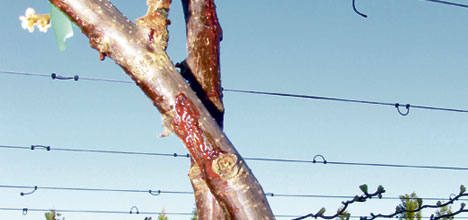
Wet weather two weeks ago is being blamed for a huge increase in Psa infections spreading through Te Puke kiwifruit orchards.
There are 255 new Psa-V confirmed results this week, the largest weekly increase so far this spring. It brings the total number of infected orchards up to 689, a 38 per cent increase on the 500 infected orchards from last week.
Wet weather has caused the number of Psa infections in Te Puke kiwifruit orchards to spread rapidly, reaching a record weekly increase.
The latest Kiwifruit Vine Health figures also show Psa-V now affects 20 per cent of New Zealand kiwifruit orchards and is infecting 28.3 per cent of the canopy area on those orchards.
The recent outbreak of leaf spots on all kiwifruit varieties in the Te Puke region reflects an infection period that is likely to have occurred two to three weeks ago says KVH spokesman Terry Richards.
Vine surfaces stayed wet for a prolonged period because of persistent rain, allowing Psa-V to incubate, with leaf spotting now appearing.
'The inoculum or bacteria needs wet conditions to grow or multiply,” says Terry.
'In hot dry conditions, it's just dormant.
'So it needs damp conditions for a period of time, once it has that, the bacteria is multiplying and spreading across the wind. So if it's spreading across vines then the vine must be protected.
'You can't cure that at the moment, once it's in the vine. You need to prevent it arriving. 'You need to kill it when it arrives.”
Sprayers have to be set up in such a way so there is spray coverage of all parts of the leaves says Terry.
This is to ensure there is complete coverage so when the wind blown bacteria arrives, the spray is acting as a barrier and kills it.
There is a range of sprays available and the toolbox is getting bigger as more and more products are tested and found to be effective. They are listed on the KVH website www.kvh.org.nz
'I think the infection that we were finding in the winter was infection that had arrived in the late summer and autumn,” says Terry.
'It gradually built itself to a level in the vascular system of the vine then it started to express itself once the spring came along.
'The infection we are getting now in spring is new infection being blown in as a result of the conditions. We know from what the scientists are telling us the leaves need to be wet or damp for a period, I think around 48 hours. The odd passing shower isn't a problem, but prolonged periods of wet are a problem.
'It would be a huge mercy if it was a hot dry spring, it's pretty virulent though.”

0 comments
Leave a Comment
You must be logged in to make a comment.