


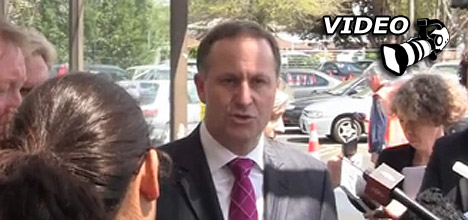
Prime Minister John Key says the Ministry of Social Development is working with the Tauranga Chamber of Commerce to create a financial assistance plan in the wake of the Rena disaster.
Prime Minister John Key outside the Rena operations centre on Cameron Road today. See video below for full interview.
Speaking outside the Rena operations centre on Cameron Road today, John Key said the government is working with the chamber to provide financial help to Bay of Plenty businesses in the commercial fishing and tourism industries affected by the Rena wreck.
Tauranga Chamber of Commerce is seeking advice from Canterbury Chamber of Commerce to get a sense of what programmes have worked in the wake of the Christchurch earthquake.
For the full interview watch the video below.

5 comments
Where do you stop
Posted on 14-10-2011 17:10 | By Justintime
The incident is tragic for the BOP and those business operators. But will the government do the same to ALL kiwifruit growers who lose their orchards through a biosecurity failure. Where do you stop?
Handout mentality is alive & well.
Posted on 15-10-2011 09:31 | By gadstuff
It appears we live in a "handout society" where what-ever happens the poor old tax payer has to bail everyone out. Why haven't these businesses got "loss of income" insurance, which isn't a big expense & is tax tax deductable.
Business is a risk not a guarantee
Posted on 15-10-2011 13:55 | By Kin
I object to paying taxes on my pittance of a wage in order for it to be used to pay out to rich business owners when the shit hits the fan. They're probably dodging taxes with cute accounting in the good times so they should have some tucked away. i bet they've got shares and investments but I guess that must be for another rainy day.
Get your head out of yer...
Posted on 22-10-2011 08:23 | By theschizzle
1) The ones needing help aren't rich. They are small businesses who have already been badly hit by the recession and were hoping to get through next winter on the proceeds of the summer that won't be happening now. They aren't asking for financial assistance for their businesses. They want wage subsidies so they can keep the staff employed. 2) Loss of Income insurance doesn't cover this sort of issue. It only covers physical damage to the business. 3) Justintime: have they asked for it? And what are they asking for? Kin is correct, business is a risk. I don't have a problem losing my business, but it makes me want to weep knowing that my staff will be getting their redundancy notices on Monday. Especially when I've just discovered Tradestaff are apparently paying people to clean the beach. It seems 5000 volunteers isn't sufficient, eh. The Government's financial assistance package consists of WINZ supporting them onto the dole, and advising them they can get accommodation supplements and food grants. Are you all seriously telling me you'd rather pay my guys the dole for however long it takes to get another job? It would be cheaper on the taxpayer to subsidise their wages.
help poor people
Posted on 16-05-2026 08:05 | By clear_fox67
This discussion highlights how complicated disaster-related financial assistance can become, especially after environmental and economic crises like the MV Rena oil spill in New Zealand.
The debate in the comments is particularly interesting because it reflects two very different perspectives on government support. Some people see wage subsidies and emergency assistance as necessary to protect workers and small businesses during unexpected disasters, while others worry about long-term dependence on taxpayer-funded bailouts and where governments should draw the line.
I also thought the point about wage subsidies versus unemployment support was important because, in many situations, keeping employees connected to their jobs can sometimes be more economically stable than relying entirely on welfare systems after a crisis.
I was recently reading some public assistance and emergency support updates on https://8171-web-portals.pk/ discussing how targeted aid programs, verification systems, and temporary financial support mechanisms are often used to help vulnerable groups during economic disruptions, and the same principle clearly applies in disaster recovery situations as well.
Overall, this shows how financial assistance policies after major crises often involve balancing economic survival, taxpayer concerns, business responsibility, and long-term recovery planning
Leave a Comment
You must be logged in to make a comment.