


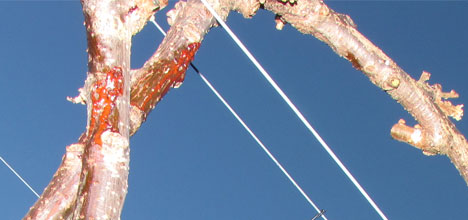
A Psa-V positive result has been received on a kiwifruit orchard in Whakatane, Kiwifruit Vine Health Inc is reporting today.
This follows the detection of the vine canker Pseudomonas Syringae pv. Actinidae on a Katikati orchard earlier this week.
A spring symptom of Psa on kiwifruit vines is a red ooze.
A total of 395 orchards have been confirmed with Psa, 312 orchards have been confirmed with Psa-V.
Most are in the Te Puke region, six are in the Tauranga priority zone, one is in the Waihi priority zone one is in the Katikati priority zone.
Nearly half, 48 per cent, of New Zealand's kiwifruit hectares are now in a priority zone and 13.7 per cent of New Zealand's kiwifruit hectares are on an orchard with Psa-V.
The new Katikati priority zone established following this week's discovery there, includes 246 orchards covering 708 hectares.
Most of the orchards identified with Psa are in the Te Puke region – 334 or 88 per cent.
Psa-affected orchards have also been identified in other regions as listed in the table below.
A new Whakatane priority zone includes 58 properties and 287 hectares of kiwifruit orchards. Extensive monitoring of orchards is continuing.
Growers are urged to take all necessary steps to protect their orchards as industry authorities are still uncertain of the total impact the canker will have on crop volumes.
This is for two reasons, says Zespri communications advisor David Courtney.
The industry is coming off a bumper crop last year and this year's crop will be down anyway, and they are still unsure how far the Psa infection has spread over the winter.
'We haven't really started doing the figures apart from clearly knowing that it's going to be down,” says David.
There is no denying the volume is going to be down, but that's going to become clearer over the next few weeks as to what the size is, and we can start making some solid estimates.
'Because of the weather conditions and the ups and downs of the horticultural business, clearly the drop in volume is going to be compounded by the fact we are coming off the back of a large crop.”
At the annual meeting in August, Zespri CEO Lain Jager estimated a Gold crop reduction could be down to 20-24 million trays from this year's 30 million tray benchmark.
Gold orchards are hardest hit, with 65 per cent of the infected orchards so far being Gold.
The 30 million Gold trays were out of an export total of 115 million trays.
Sales revenue was $1.5 thousand million, with about one billion being returned to growers after costs.

2 comments
Leadership please
Posted on 30-09-2011 20:00 | By IanM
I'm getting tired of hearing from the industry. It's time the government got involved here, and recognised that what we have is large-scale industrial collapse arising almost certainly from a biosecurity failure. Alongside that are some serious environmental threats arising from the industry response. Why are our politicians ignoring this issue, which is deadly serious for the Bay of Plenty?
shortsighted
Posted on 01-10-2011 08:49 | By basil65
bit like MAF letting uncured pork into the country. let's decimate another producer
Leave a Comment
You must be logged in to make a comment.