


While the image of 1080 poison raining hell from the heavens might be unsettling for deerstalkers, they have to learn to think past their noses, says Aongatete Forest Restoration Trust spokesman John Howard.
He was commenting on the Taupo District Council's decision to oppose the use of 1080 aerial poison drops to control possums.
'1080 is not the issue,” says John. 'The issue really is how do we get rid of these pests; possums, rats, stoats, deer and pigs.
'We've never recommended 1080, but ERMA, the Environmental Risk Management Authority, and the Department of
Conservation have found it is still the most economic and safest way to get pests out of the native forests.”
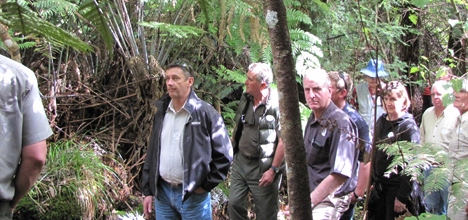
A group of city officials, including Mayors Stuart Crosby and Ross Paterson, on a tour through the Aongatete Forest to hear about how animals are ruining the forest.
John says the pest problem in the forests is a national issue and in the long run preserving the forests is far more important that preserving the hunting for deerstalkers.
'The deer should never have been there in the first place,” says John.
'We are between a rock and a hard place. We can't just sit on our hands.”
Trappers and shooters have proved ineffective and some form of control is required and it has to be done quickly.
'The deerstalkers obviously can see a situation which they need to rebuff because it cuts across their interests,” says John.
'They are opposed to it and I can see why. But at the end of the day they have to think past the ends of their noses. There is a lot of hysteria being generated.
'If someone doesn't do something pretty quickly it will become a serious national problem.”
Political efforts are being made in Copenhagen to have New Zealand's native forests recognised as carbon sinks for emission trading purposes. John says the present reality for forests like the Kaimais is they are no longer carbon sinks – they are carbon emitters because of the activity of the pests.

0 comments
Leave a Comment
You must be logged in to make a comment.