


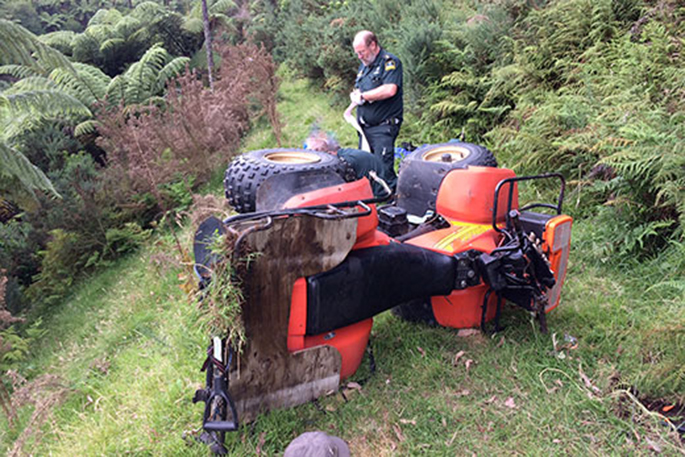
Just because you've worked on a farm for decades, carrying out routine job you've done a thousand times before - accidents happen and sometimes they're fatal.
Last year there were 19 work-related deaths on farms across New Zealand and 16 of those incidents involved vehicles, according to data released by WorkSafe this week.
WorkSafe's Agriculture Programme Manager Al McCone says of those incidents, more than 50 per cent involved farmers aged over 55 driving vehicles on sloping or uneven ground.
'These were mature and experienced people doing jobs they would have done many times before and examining vehicle fatalities from the last three years, we find that often the driver/rider had set out to do a fairly routine task like spraying or stock work.”
There were common factors in all the incidents, like operators or others being hit by the vehicle, or being killed during a rollover.
Al says to keep yourself safe people need to make sure their vehicles won't move when they are exiting it, and to wear seatbelts when in the cab or roll frame.
'Extra care is needed when working on or near slopes, especially on tracks with steep drop-offs.”
The quads involved in the fatalities ranged in age and size, and were often in sound mechanical condition. But low tyre tread depth and under-inflated or uneven tyre pressure was noted as a possible contributing factor in some cases.
Often the vehicle had slid on a slope and a number of incidents involved quad bikes overturning into drains, ditches or waterways, adds Al.
'Good practice like keeping at least one metre from a stream or culvert edges, stopping and dismounting to spray, and working out ‘no go' areas on farm in advance could all help prevent incidents.
'Any vehicle is only as good as the way it is maintained and used. Make sure tyres and brakes, especially the handbrake on tractors, are in good condition, and it is essential operators know how to use the vehicles properly.”
Farmers, both employers and employees, are also more likely to be working alone at busy times, so having a plan in place for lone workers meant if anything went wrong the alarm could be raised.
'Like most risk management processes, it doesn't need to be complicated. There are a number of solutions that send out ‘man down' or just location signals.
'If you can't afford these, then get a simple system in place where people check in at agreed times. If they don't, then check on them.”
WORKSAFE'S TIPS FOR KEEPING YOURSELF SAFE ON THE FARM:
- When driving any enclosed vehicle, or vehicle with a roll frame, seat belts must be worn. If there is likelihood of head contact with the frame, helmets should be worn.
- Drive the vehicle at a speed suited for the conditions and terrain.
- When riding unenclosed vehicles, wear a helmet.
- Don't take any vehicle onto slopes beyond the capabilities of the driver/rider or vehicle - especially when carrying spray tanks or towing trailers.
- Make sure carried equipment does not exceed the vehicle's capabilities and that equipment is properly installed on the vehicle.
- Stay clear of drain or stream edges, especially where poor light and/or growth obscures irregularities in the surface of the bank's edges.
- When getting off a tractor, make sure the brakes are on properly and will not move.
- Quad riders must be physically able to ride actively and to escape the vehicle quickly if need be.
- Stop riding the quad if your attention is diverted to other tasks, such as working your dogs or spraying. This is especially important on slopes or uneven terrain.
- Take care on uneven ground where a vehicles front wheel can drop unexpectedly.
- Make sure quad tyres have tread depth in line with manufacturers' instructions and that they are correctly inflated.
For more information on staying healthy and safe on farm visit: www.saferfarms.org.nz

0 comments
Leave a Comment
You must be logged in to make a comment.