


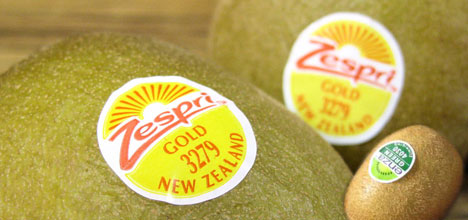
Turners & Growers and Zespri are continuing their public spat over cultivars with Zespri claiming T&G is more interested in political point scoring than commercial progress.
T&G opened the latest round saying Zespri opposed T&G's latest application to export its own cultivars from New Zealand in order to preserve its monopoly.
'This is a deeply flawed, anticompetitive system, which allows unethical monopolistic behaviours that would not be tolerated in any other industry or international market,” says Turners & Growers managing director Jeff Wesley.
T&G's application to export its ENZAGold, ENZARed and Summerkiwi varieties through a collaborative marketing agreement with Zespri was lodged with the industry regulator, Kiwifruit New Zealand (KNZ) late last year after repeated public calls by Zespri and the government for Turners & Growers to 'work through the system” and assurances by Zespri head, Lain Jager that 'the collaborative marketing provisions provide the best and least-cost path forward for Turners & Growers and others to develop export opportunities.”
Zespri opposed Turners & Growers' application and it has been turned down by Kiwifruit New Zealand.
The Turners & Growers application was a key test for the monopoly regime, says Jeff. Zespri, KNZ and the government claim the decade old kiwifruit regulations can work for Zespri's competitors who have developed their own new varieties for export from New Zealand.
T&G sought approval to export Gold, Red and Summerkiwi varieties to multiple countries on four renewable five-year terms in what it says is one of the most comprehensive and detailed applications presented to Zespri and KNZ since the regulations came into force in 1999.
Turners & Growers' discussions with Zespri focused on the need for trust between the companies and a five year rolling term for any deal made to allow for certainty for New Zealand growers investing in ENZA varieties, says Jeff.
Zespri would not engage on anything more than a 1-year trial into limited markets and insisted on a gag clause in any agreement to limit Turners & Growers criticism of the monopoly.
Zespri claims the T&G's application was to export multiple varieties, some of which have not yet been planted in New Zealand, to unspecified markets for a period of five years with renewals for up to 20 years.
'The application could not be supported by Zespri because it amounted to open slather,” says Zespri chief executive officer Lain Jager.
'T&G did not show it was in the best interests of New Zealand kiwifruit growers – as the law requires.
'Should T&G be interested in coming back with a more serious proposal that it can show is in the interests of New Zealand kiwifruit growers, we are confident we will be able to advise the regulator that we support it.”
Jeff Wasley says the result will be embarrassing for the government.
'We have done all we can to work within the monopoly controlled system, but the decision by KNZ to turn down our second application to export our new varieties proves that the system, which has only ever been marginal at best, is now completely outdated and does not work.
'The government's claim that the collaborative marketing system allows others from New Zealand to export has been shown to be a charade.”
KNZ's decision to turn down the T&G application leaves the government trying to explain to its international trade partners why there is a significant gap between the theory of the Zespri's monopoly control over New Zealand kiwifruit and how it works in practice.
'It's also misleading for the government to suggest that companies other than Zespri can export kiwifruit from New Zealand, when less than two per cent of kiwifruit is exported under CMA's (collaborative marketing agreements) each year, and a quarter of those are granted to Zespri itself,” says Jeff.
Lain Jager says collaborative marketing is working. Zespri already works with 13 companies, including T&G, which is exporting kiwifruit beyond Australia.
'This includes, for the first time, the recently announced collaborative marketing arrangement involving a new variety, First Gold developed by Gisborne-based First Fresh,” says Lain.
Jeff says the high-profile failure of the kiwifruit regulations comes soon after OECD suggestions for the government to remove Zespri's monopoly over the country's kiwifruit exports, saying it is a barrier to trade and investment.
The process highlights the misleading nature of the government's notification to the WTO to protect Zespri's monopoly, says Jeff.
'The five current members of KNZ own shares in Zespri.”
The process has been unnecessarily lengthy and KNZ's decision not to grant a CMA to Turners & Growers blocks ENZA from another season of exports, says Jeff.
'We will have the first New Zealand grown red kiwifruit for export, while Zespri's red cultivar is still only being trialled on orchards here.
'We want to get ENZA's NZ-grown premium kiwifruit varieties into export markets as soon as possible to start earning premiums for growers and a much needed boost for exports.”
T&G's first application for a CMA was made in 2008. Concern over the process and the application's rejection was the catalyst for T&G to begin its campaign to gain free and unrestricted export access for its new kiwifruit varieties. The second application was lodged on November 16, 2010.
The government's 2025 Taskforce stated in 2009 that Zespri's ‘monopoly powers' should be revoked, and rejected the government's claim that the monopoly should stay if a majority of growers back it, saying: 'It is not clear what public policy interest would justify a Zespri monopoly that prevented, say, 35 per cent of growers who wished to do so from selling their fruit abroad through other companies. The vines and fruit are private property.”

1 comment
MOOT POINT
Posted on 19-06-2011 15:50 | By WARTS N ALL
Are they fighting over Kiwifruit or PSA ownership rights ?
Leave a Comment
You must be logged in to make a comment.