


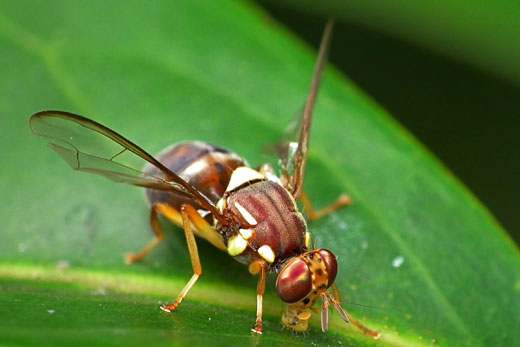
Australian scientists are visiting New Zealand this week to talk to Plant and Food Research scientists about the Queensland Fruit Fly.
It is a rare event, says Better Border Biosecurity (B3) director Dr David Teulon.
A Queensland fruit fly. Photo: Supplied.
'It's rare to have such a varied group of research, government and industry representatives from both sides of the Tasman at the same meeting, and so we expect the workshops will create a positive platform for discussion and information sharing,” says David.
'By coordinating our scientific efforts we can help develop applied solutions for dealing with this pest and preventing its establishment in New Zealand.”
Queensland fruit fly (Qfly) is a serious horticultural pest in Australia and one of the most important biosecurity threats to the horticultural industry in New Zealand.
Fruit fly causes losses of up to $159 million a year in Australian fruit and vegetable crops alone. Ongoing research and development is critical to managing fruit fly in Australia, reducing production costs to growers and increasing market access opportunities.
The insect is capable of infesting more than 100 fruit and vegetable species, inlcuding kiwifruit and avocado. If the pest became established in New Zealand, it would create significant problems for the primary sector by damaging crops and causing market access issues.
Plant & Food Research and Better Border Biosecurity (B3) are hosting scientists and biosecurity operatives from Australia's Plant Biosecurity Cooperative Research Centre (PBCRC) and SITplus next week for a week of workshops, meetings and tours, to manage the ongoing threat.
The workshops will coincide with a meeting of the recently formed New Zealand Fruit Fly Council – a collaboration under the Government Industry Agreement (GIA) between Government and a number of industry groups acting as the operational body for fruit fly response and management.
The workshops will include a review of past and current research on invasive fruit fly and look to identify priorities for future research. Topics include surveillance, detection and trapping, risk assessment, and management methods such as Sterile Insect Technique and lure and kill treatments.
Although traditionally found in Queensland and New South Wales, Australian scientists studying Qfly have noticed the population establishing itself further south in Victoria. It has been suggested that this may be due, in part, to a changing climate producing longer warm seasons and a reduction in cold events.
'Factors such as climate change, along with increasing and evolving trade and tourism, pose ongoing challenges around biosecurity, requiring forward-thinking and vigilance, and Qfly is no exception,” says Plant & Food Research Science Group Leader Professor Max Suckling.
B3 is a multi-partner, cooperative science collaboration that researches ways to reduce the entry and establishment of new plant pests and diseases in New Zealand, and is aligned to New Zealand's Biological Heritage National Science Challenge.
The PBCRC is a collaborative research network of 27 participating organisations from Australia and around the world that develops and deploys scientific knowledge, tools and resources to strengthen plant biosecurity RD&E and capacity. Plant & Food Research is one of only two New Zealand members.
SITplus is a collaboration of research, regulatory and funding agencies that have joined forces to develop the use of Sterile Insect Technique (SIT) for the management of Qfly.

0 comments
Leave a Comment
You must be logged in to make a comment.