


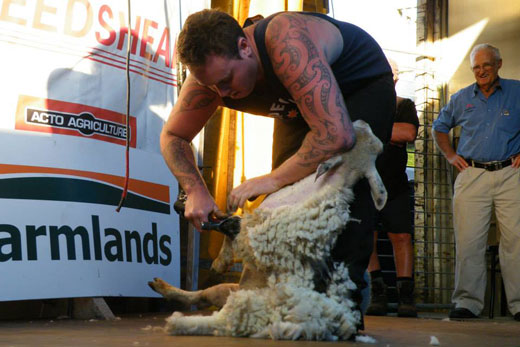
With sheep shearing accounting for more than $3 million in injury claims to ACC over the past three years, farmers are being urged to take care as pens fill up in wool-sheds across the country.
Especially those that shear only a few sheep a year are at risk of injury, rather than the professional shearers.
Shearing sheep can be a risky business, especially for people who only shear a few sheep each year. Photo: file.
'Over 60 million sheep are shorn each year and many more crutched. This work has a high risk of injury but generally professional shearers and wool handlers have the technique, fitness and equipment-care practices to manage the risks.
'Farmers who shear and crutch a few sheep now and again, rather than full-time, are at risk through less-practiced technique, poorly-maintained gear or not physically being prepared for the task,” says Al McCone, Programme Manager for Agriculture at WorkSafe.
Last year, there were 122 sheep shearing-related injuries serious enough to require funding support from ACC. Leading injuries included back injuries, sprains, strains and muscular stress caused by prolonged bending.
WorkSafe New Zealand's Safer Farms programme is working with the rural sector to promote good health and safety practices and reduce the high rates of accidents and fatalities on farms.
It has published a fact sheet on sheep-shearing, after wide consultation with the industry, to coincide with the new Health and Safety at Work Act 2015.
Comprehensive guidance will be available by the end of July. This is good timing because shearing will be getting underway on many farms over the next few months.
Al McCone, says the beginning of pre-lamb shearing in a few months means increased handling of stock and greater risks.
Injuries like sprains and strains can be avoided by using the correct techniques while handling or shearing sheep. Checking and maintaining shearing equipment is also an important aspect of safety and efficiency.
'Make sure grinders are stable and secure when being used, and check to see that your hand pieces are in good working order.
'Hygiene is important, always wash and dry hands after contact with sheep to help avoid zoonotic diseases like leptospirosis,” says Al McCone.
'Catching and dragging sheep to the shearing stand, and the actual shearing, all require good technique – as do the wool handlers whose job it is to prepare the wool for sale.
'Keep your back straight, especially while dragging or lifting, and avoid twisting your spine. Like bowling a cricket ball, a good technique is incredibly important if you're to avoid injuries.”
Farmers who are preparing for shearing need to make sure that their woolsheds, machinery and associated facilities are in good working order.
'Make sure the wool press is working well, all the safety features are functioning, and that anyone who uses it knows what they are doing.”
Good, clear communication between farmers and shearing contractors (or those being employed directly) is essential to make sure the work is safe. Before you or others begin any job on the farm, stop and consider what you need to watch out for, and how to complete it safely.
More people are killed farming than in any other industry in New Zealand – 18 people died in farm-related work incidents in 2015.
In addition to deaths, there are thousands of injuries that lead to a loss of productivity and income for farmers. Advice and a range of health and safety guidelines are available at www.saferfarms.org.nz.

1 comment
know what this is about
Posted on 10-04-2016 13:05 | By The author of this comment has been removed.
Me was working in a woolshed as a rousy at Mt Linton Station Ohai,the 12 stand shed, sheared 40,000 sheep in under 9 weeks, wages were awesome then at 15yrs old 10 shillings hr,=$1,00 i was king,doesn,t take long when you putting through 200+ day each,5,000 could be kept under cover then,never had many complaints then or ACC,pussies today are soft and complain about a paper cut,also worked for a big contractor in Taupo, and a shearer was doing a long blow ,the sheap kicked and he run the handpiece right up his left arm and opened it up from the wrist pass the elbow, we took him into doctor in town about half hr away in his 37 chev coupe,they stiched him up and he was back at work on the next monday,we were tough back then,we didnt have hyd,. presses then it was a 2 handle one,THANKS
Leave a Comment
You must be logged in to make a comment.