


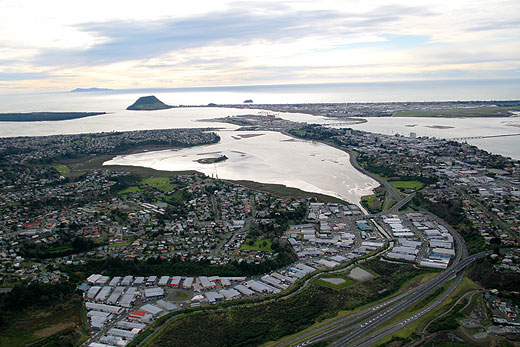
Forget Ponsonby or Herne Bay. If you are looking for capital gains this year, what about Gate Pa in Tauranga?
New data released from CoreLogic shows the strongest house price growth over the past year has been in areas outside central Auckland.
Across the country, Meremere topped the chart in the year to February 1, up 33.9 per cent to a median $260,950. It was followed by Weymouth, up 30.4 per cent to $557,850 and Clendon Park, where prices rose 29.8 per cent to a median $495,000.
The increase is calculated based on the median of all property values on February 1, compared to the median a year before.
Hamilton, Tauranga and Whangarei also experienced strong growth – Gate Pa in Tauranga saw prices rise 26.1 per cent to $357,950 over the year and Morningside, in central Whangarei, experienced a 23.3 per cent increase in median value to $296,550.
CoreLogic analyst Nick Goodall says the areas are all affordable by Auckland standards and are benefiting from Auckland investors and house-buyers looking further afield.
"The sore thumb sticking out here is Meremere. We are a little cautious about this, considering there are only 167 residential properties here, but nonetheless, being just south of the Auckland Council border it has likely seen the benefit of Auckland workers looking further south for affordable housing."
He says Auckland investors have been buying in increasing numbers in Hamilton over the past year, although their activity has started to level off over recent months.
Goodall expected the trend to continue this year. He says there is probably be strong price growth in the top of the North Island throughout 2016, driven by the impact of Auckland buyers and the comparative affordability of the smaller centres.
But others are predicting the price growth may spread further afield, too.
Cameron Bagrie, ANZ's chief economist, says he expects to see the most house price inflation in Nelson, Wellington and Hawke's Bay.
"Auckland has been the big boy that went first and it went huge. Then over the next 12 months the ring around Auckland - Tauranga, Hamilton, Whangarei - went and I still think those regions are going to go really well but when it comes to the next cab off the rank in terms of being dragged up, the obvious ones are Hawke's Bay, Nelson and Wellington."
He says those regions have not had much price movement for a long time and Hawke's Bay was also showing signs of increased activity. "Auckland is going backwards, prices are falling. I think that will continue for the next six months."
Analyst Rodney Dickens, of Strategic Risk Analysis, was picking small towns to outperform.
He analyses available supply against buyer demand and says Bay of Plenty was in the strongest position for price growth based on that calculation.
"Tauranga is strong already so we might be looking at places like Te Puke or Katikati. Those towns are close enough to bigger provincial cities where prices have gone up. Around Hamilton, there's Te Awamutu, Morrinsville, Cambridge. Some of those are already performing quite strongly."
He says the supply and demand equation was tight enough in parts of Northland, Waikato and Bay of Plenty to lead to price growth of more than 15 per cent this year, but smaller centres could see up to 30 per cent.
Dickens says, if the new rules had not been introduced last year introducing a two-year bright-line test for capital gains and the need for an IRD number, many of those towns would already have been flooded by "quick flick merchant" investors.
"Last year I heard about one small Waikato town where a person came in and bought up all the homes in the market at first-home buyer level because that's where the rental yields are highest. The tax changes seem to have taken that out of the market temporarily at least."
Mortgage broker Glen McLeod, of Edge Mortgages, says he has seen more applications for loans to buy property in Whangarei, Hamilton and Tauranga in the past year than he has seen in his career. "We are doing two or three a week compared to one or two a year."
He has dealt with a number of clients who are moving to jobs in Tauranga. But he says they needed to consider how they would get back into the Auckland market if the move did not work out.
Goodall says while prices might catch up a bit, homeowners outside Auckland should not expect to see growth equal to Auckland's over the long term.
"The fundamentals aren't as strong. There are so many factors pushing Auckland prices. The net migration is so much stronger and the low supply, Auckland is not the same as anywhere else."
Bagrie says it was important for the wider New Zealand economy that Auckland's housing market slows down.
"If I saw a continuation of the past two years in Auckland for another two years I would have grave concerns for where the economy would be in 2018, 2019.
'That's a prime situation for a bubble that could pop. The rubber band is pretty tight now, that's why a lot of people on the ground are looking at shifting out of Auckland. It's not just unaffordable housing but the transport costs, the time getting to and from work. The regions have that attractiveness."
- Additional reporting by Stuff

3 comments
Not
Posted on 28-02-2016 15:46 | By Capt_Kaveman
Here, i went to a house auction the other day and only half sold, some didnt even get a bid
Growth
Posted on 28-02-2016 16:22 | By R1Squid
Of the current magnitude has not been prepared for. Tauranga will soon be just like Auckland - one huge carpark.
Blame National
Posted on 29-02-2016 10:06 | By Towball
We have got such a mass migration of people into N.Z that there is no way it was ever going to be sustainable. Just another classic example of the Key club lining their pockets at the expense of middle class people again. The majority that pay for everything receive nothing supporting the wealthy who pay little or no tax then supporting the tax dependent we are never going to get ahead. Debilitating frustrating cruel.................
Leave a Comment
You must be logged in to make a comment.