


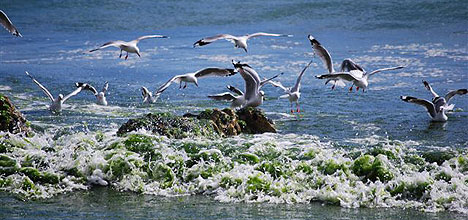
The early signs are indicating there will be a bumper sea lettuce ‘crop' collected from Tauranga beaches this summer.
Fresh sea lettuce is nutrient rich. Photo by Ann Carruthers.
Contractor Dean Kelliher removed 140 tonnes of sea lettuce from the Mount Maunganui main beach last week. This week he is clearing the early accumulations from the Matua beaches, from Ferguson to Kulim parks.
Last summer Dean shifted 3.5 thousand tonnes of sea lettuce from local beaches.
'We do try and hammer it between now and Christmas on the Matua peninsula as is required,” says Dean.
'There does seem to be a little bit more than what we had this time last year.”
Dean's sea lettuce clearances round Tauranga are jointly funded by the Bay of Plenty Regional Council and the Tauranga City Council. Dean's also made a couple of regional council funded forays to Ongare Point and Kauri Point. While they are in the Western Bay of Plenty District Council's region, the WBOPDC has a policy of not funding sea lettuce removal.
Dean hasn't been to Waihi Beach yet. He checked with the RC after reading a letter from a Waihi Beach resident complaining about sea lettuce there, but they haven't yet complained to the council.
'What we try to do is plan it out but that doesn't take into account any major dumps,
like the dump on the main beach two weeks ago,” says Dean.
'The surf is still quite green, but we got the majority of it off the beach before it turned.
No one knows how much is sitting out there beyond the waves.”
He thinks he could pick up many thousands of tonnes of sea lettuce over the summer, if it was actively sought out, but he's on a limited budget.
'We are still sending it off to be composted so something is being done with it at least.”
Sea lettuce is not a problem unique to Tauranga or New Zealand.
Tauranga's sea lettuce problems were originally blamed on agricultural run off. The blame shifted a few years ago to weather conditions, but the pendulum is swinging back toward dodgy environmental factors.
For the past year, polytechnic students have been taking samples of nutrients from sea lettuce taken from different sites both within the Harbour and the open ocean.
Using stable isotope analysis, they found sea lettuce samples close to shore have high levels of nitrogen. The nitrogen amounts taper off in samples taken from the middle of the harbour, suggesting the flow of nutrients is from shore to sea.
The students' project suggests the sea lettuce blooms are influenced by land based activities like sewage overflows, runoff from farmland and urban siltation - contradicting the current view that sea lettuce blooms are caused by natural fluctuations in the El Nino Southern oscillation (ENSO) cycle.
Strong westerlies associated with the cycle are said to cause an uplift of deep water sediments, which causes the blooms.
Although 2010 is an El Nino year, sea lettuce samples close to shore have a high proportion of the heavier nitrogen isotope, suggesting treated sewage is a strong contributor. By contrast, sea lettuce samples from deep water around Tuhua Mayor Island show a lower proportion of heavy isotopes, characteristic of deeper, unpolluted water.
The students' findings were presented at last week's 2010 Coastal Management Conference in Whitianga.

2 comments
sue
Posted on 28-11-2010 15:36 | By newmontsuck
i imagine there is a use for sea lettuce beyond composting so hope the council develops a plan where they sell it and the profits pay for ongoing clean up or that the contractor pays council a portion of the profit he makes from disposal....
hum
Posted on 28-11-2010 17:51 | By Capt_Kaveman
i wonder how much of this comes from the fert works and fert ships since it is so close to the harbour
Leave a Comment
You must be logged in to make a comment.