


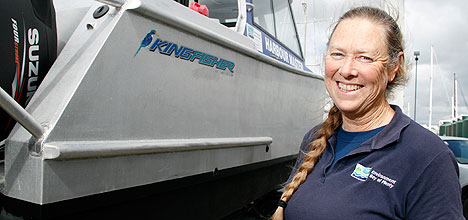
Tauranga Harbour Master Jennifer Roberts says speeding boaties will be targeted during summer, warning they risk incurring a $200 fine for breaching the speed limit.
Jennifer Roberts is urging boaties to adhere to 10 basic safety tips before heading out on the water. List below.
Between Boxing Day and Waitangi Day, at least one Harbour Master patrol boat will be out on the water on a daily basis.
Jennifer says one of the biggest problems is boaties who exceed the five knot speed limit within 200 metres of shore.
She says people on jet skis and boats towing ski biscuits are also flouting speed rules.
'Ninety nine per cent of boaties are really good. Of the one per cent that are not good, probably 90 per cent of those didn't know.”
'So it's a very, very small percentage who disregard the rules.”
There are two boats and a jet ski available for Harbour Master staff to patrol Tauranga waters.
'We are going to be out in force. We will be looking for people who don't comply with the rules.”
Jennifer says $200 fines will be issued to all boaties who flout the Navigation Safety Bylaw.
After Waitangi Day, Harbour Master boats will continue weekend patrols until Easter.
Top Ten Safety Tips:
1. Check the weather and tides before you leave
The weather conditions can change very quickly in this part of the world. Obtain the Marine Weather Forecast before you go out. Listen for regular updates to the weather forecast. Check the tides before you leave – in Tauranga Harbour the tidal flow through the north and south entrances can be particularly strong around Spring tides. 'Keep your weather eye open.” If in doubt, don't go out!
2. Have suitable lifejackets for all on board
Life jackets must be the right size to be of any use. Make sure your children's lifejackets are the right size for them and are properly fastened. You must all wear a lifejacket when crossing any bar; where there are strong tides, rough water or in adverse weather conditions.
3. Do not overload your boat
Overloading, with consequent loss of stability and seaworthiness, is one of the causes of boating accidents. Don't overload your boat. Stow heavy items low down in your boat and make sure they are well stowed or secured.
4. Obtain local information of the area
Always carry up to date charts of the area you operate in. Know how to use a chart and what the various symbols mean. Identify the rocks and hazards in your area. Know where the underwater cables are and avoid anchoring near them. Understand the buoys and beacons marking the sand banks. Tauranga harbour awareness chartlets and Harbour Guides are available free from the Harbour Master's office at 6 Rata Street, Mount Maunganui.
5. Take two means of communication with you
Make sure your two means of communication – flares, VHF Radio, EPIRB, cell phone – will work when wet. Put your cell phone into a waterproof plastic bag. Make sure you know how to use your VHF radio, EPIRB and flares. According to Maritime NZ, 56% of boating fatalities over the last 7 years in NZ could have been prevented had the victims carried at least one reliable form of communication!
6. Know and observe the Collision Rules
Just like on the roads, the rules are there to ensure everyone stays safe. You must know the Rules of the Road at Sea, if you are operating a boat on the water. You can attend night classes at your local college or enrol at Coastguard boat courses. Enrol for a refresher course if it's been a while since you learned the rules.
7. Make sure your boat and motor are well maintained
Check your battery, electrics and fuel before you set out. Clean out your fuel filter regularly to keep foreign particles from contaminating your fuel. Keep your motor well maintained. Make sure your battery is well ventilated and properly secured into the boat. Keep your boat watertight and seaworthy to keep the water on the outside. Do not leave shore in a leaky boat!
8. Keep your safety equipment up to date, working and make sure that everyone on board knows how to use it
Have regular practice drills for various emergencies: Man Overboard, Fire, Capsize and Sinking/Abandon ship. Discuss with your family a Plan of Action and make sure everyone knows what to do. Make sure your torch has fresh batteries. Keep your flares and fire extinguishers up to date and know how to use them.
9. Let someone ashore know where you are going and when you expect to return
Leave a note with someone responsible, detailing where you expect to go; how many people are on board and when you expect to return. A Two Minute Form is ideal. You can collect Two Minute Forms from the Coastguard or the Harbour Master's office. Or make a radio Trip Report (TR) with Coastguard Radio (channels 62 or 83) or Plenty Maritime Radio (channels 16 and 68).
10. Operate your boat safely
Always travel at a safe speed. Do not exceed 5 knots within 200 metres of the shore or a structure or a boat flying the Dive flag (International Code 'A” flag); or within 50 metres of another boat or a person in the water. Did you know that 5 knots is roughly equivalent to a brisk walking pace? You must also ensure that your boat's wake does not cause unnecessary damage to other boats or structures, or harm to other people. Do not impede the navigation of a vessel over 500 tonnes (in Tauranga harbour, that means give way to all cargo ships and passenger liners –our local fishing boats are all less than 500 tonnes). Do not anchor in the shipping channels!

0 comments
Leave a Comment
You must be logged in to make a comment.