


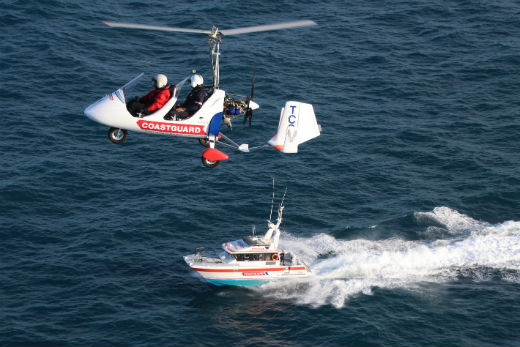
Tauranga Coastguard is trialling the use of a gyrocopter during search and rescue operations in the Bay of Plenty in what is a first for New Zealand - and possibly the world.
In the past, coastguard has used fixed wing aircraft to aid their efforts, and lately the TECT Rescue and other available rescue helicopters have helped out.
Tauranga coastguard is evaluating the use of a gyrocopter in search and rescue operations. Photo: Supplied.
But now the two-seater machine is in a trial phase, and may become fully operational following the evaluation process which is expected to take another couple of months, says Tauranga Volunteer Coastguard chairman Chris Phillips.
'We've had it up on numerous occasions during exercises, but it can't go into active operation yet," says Chris.
The gyrocopter offers an extended and cost effective search and rescue option, reducing the time that boats need to be on the water.
'Coastguard has always operated an air patrol,” says Chris.
'There are five air patrol stations around the country which use charter planes to do their work, but that's getting less and less use with the likes of the TECT Rescue Helicopter and Westpac Helicopters, because they are a much better search platform.
'But the cost of what we are putting through a trial phase is much, much better than the cost of a plane or a rotary wing.”
Twin-engine search aircraft cost $400 an hour, while helicopters cost $1500-$2000 an hour to operate, says Tauranga Coastguard operations manager Simon Barker. The operational costs of the gyrocopter for the coastguard are $65 per hour plus GST.
But the biggest cost saving for the coastguard is in reducing the time their boats are out on the water.
The Tauranga coastguard's TECT Rescue Powercat, with twin Yanmar diesels, consumes 200 litres of diesel an hour at speed, though it uses much less when searching at slow speeds.
The gyrocopter model being used can fly at up to 110 knots (203.72kmh) and as low as 25 knots (46.3kmh). In a head wind it can fly at near hovering speeds.
Simon says with a trained observer on board, the device can search a large area in a short amount of time.
In an exercise last Sunday, the on-board observer found a floating object in a 2.5 square mile search area in an hour. A similar search would take four hours by boat.
'The exercises show that a key person is the observer in the gyrocopter,” says Chris.
'He's got to have boating experience, to know coastguard search procedures and terms while being able to communicate with the coast guard on marine VHF channels, and pass directions to the pilot on intercom.
'We want to be using the cream of the crop up there.”
The report on the Tauranga initiative and decisions will also be passed on to Coastguard NZ where it is expected to become part of the national organisation's review of its aircraft use.
The German-made Autogyro has a range of about 300 miles (482.84km) which is about three hours in the air, and runs on pump petrol. It can fly in winds of up to about 40kts (74.08kmh). The aircraft is supplied by Tony Unwin at Gyrate NZ Ltd.
'We've been agent for them here since 2006 have about 20 in the country,” says Tony.
'They are a very weather capable and a very under-rated aircraft.”
He thinks it's the first time they have ever been used officially in a search and rescue trial.
'Although the pilots that we have got flying them have got commercial licences, you are only required to have a microlite licence,” he adds.
'We have been doing flying trials for about two months - looking for kayaks and people in the water, that kind of thing.
'The coastguard have been working up their procedures so the communications between the boats and the aircraft are improved. I think it's beginning to be quite effective for them.”
Gyrocopters or autogyros gain their lift from a large free rotating overhead rotor, and are driven through the air by a small aircraft engine. They can also take-off in short distances.

1 comment
Wisechief
Posted on 18-02-2015 08:58 | By Wise Chief
Finally some intelligence is coming to the fore in this town. Me and mates have heavy lifter extreme range solar come hydrogen fuel cell powered drone on its way able to land and take off on water and operate in high winds. These people would be wise to come have look at it when we ready before years end. It is VTOL and able to carry 100 kg and more. Thus can lift person out of water using grappling hook. It will be able to be controlled via remote and also able to fly around the world autonomously.May be open for outside investment so stay tuned.
Leave a Comment
You must be logged in to make a comment.