


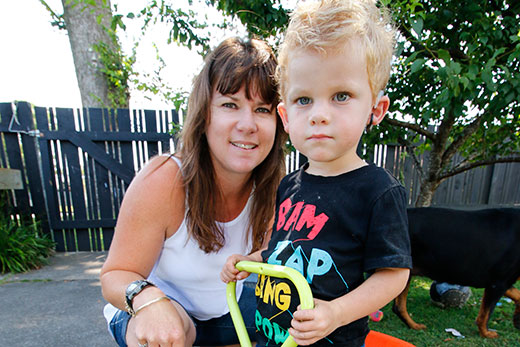
To most people, two-year-old Jack Coombs looks like the average toddler.
But the Tauranga boy and his family have been on a journey since he was born with hearing loss – and it's not over yet.
Kirstin Johnson-Coombs and her son Jack are still on a journey to see him go to school at age without a teacher aide. Photo: Bruce Barnard.
Mother Kirstin Johnson-Coombs says while 12-year-old daughter Mackenzie's hearing is fine, her 10-year-old son Reid was born with a hearing loss and uses hearing aids.
This prompted an audiologist to screen Jack at birth, and find a genetic hearing trait in the family.
'On day two, Jack failed newborn screening and on day four was diagnosed with a hearing loss,” says Kirstin.
In 2013 Jack, aged about 18 months, received one cochlear implant. When he was switched on two weeks later, Kirstin says he responded immediately.
'He turned around instantly and responded to his grandmother, which made her cry.”
Then one year of rehabilitation via The Hearing House followed, with treatment slowly activating his brain's electrodes, allowing him to gradually hear.
Last year Jack received a second implant at age two-and-a-half, from the Government's bilateral cochlear implant programme for those aged under six.
'When he had his first cochlear implant he got to the stage where he would recognise his name. After his second implant, we'd take the first one out and he wouldn't recognise his name again.”
Jack then received another year of rehabilitation for his new implant.
'Without his cochlear implants, he's deaf.”
Kirstin says Jack receives all treatment via The Hearing House. 'They're great and they cater for us up there.”
Jack can now hear with his implants in 'but his language is still behind a hearing child”.
And the journey is a bumpy one for Kirstin and husband Brad. 'It's been very, very frustrating. If you can imagine reasoning with a toddler who can hear and communicate – try reasoning with one that can't.”
Today Jack is saying a few words but isn't talking like a hearing child.
'It's so hard to understand what he wants, but it is slowly getting better.”
Kirstin says Jack is very full on and active, so respite care via a home-based carer three times a week helps her have a break.
'Also because of him being around us [his parents], Hearing House and rehabilitation, he wasn't actually spending much time with other kids before.”
'But he needs to be around kids so he knows they talk and he can learn to talk.
'And it's been wonderful – he's now learning how to be a child. He can hear very well – and he understands a lot more than people give him credit for.”
Now Jack's playing catch-up with his language skills, so he can go to school at age five.
'Ideally, so he can go to school without a teacher aide,” says Kirstin.
'We're determined to get that done. It's just constant repetitiveness and feeding language into him.”
Kirstin says the Hearing House team is fantastic. 'They've had a huge impact on our lives. I'd say through the journey they've been the most supportive for us.
'And some of the staff wear hearing aids or cochlear implants, so they really understand what it's like.”
The Fabulous February – dubbed FabFeb – healthy eating challenge this month can help raise funds for The Hearing House.
The new fundraising initiative asks participants to go sugar-free for February and raise money for children's charities such as The Hearing House.
FabFeb Foundation CEO David McGrath says their mission is to raise $2 million for children with disabilities in New Zealand 'and give Kiwis a gentle nudge towards living a healthier life at the same time”. To register, go to www.fabfeb.org

0 comments
Leave a Comment
You must be logged in to make a comment.