


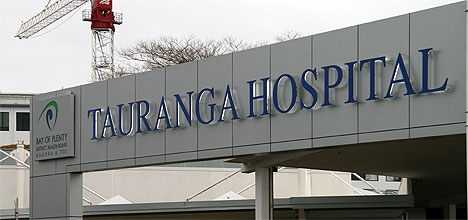
Bay of Plenty District Health Board chief operating officer Phillip Balmer is describing the impact on patient care of the radiographers' ongoing industrial action as 'significant”.
The radiographers are protesting their rate of pay and how far to backdate the rise once it is agreed.
Represented by the union APEX, striking radiographers, also known as medical radiology technicians (MRTs), began striking at Tauranga Hospital on August 2 and have continued action of varying degrees since daily.
This action is what is causing ‘significant' disruption.
'We have people arriving at our Emergency Department after hours and at weekends who require a CT or an ultrasound scan or x-ray, but as neither their life nor limbs are immediately threatened, their diagnosis and treatment is delayed until the MRT APEX members return to work,” says Phillip.
'This means patients have to spend painful days nursing fractures and like injuries until the doctors can confirm the diagnosis.
'We have had to send children home with undiagnosed broken limbs.
'The children have to return the next day or after a weekend, on a Monday, for radiology to confirm either a fracture or that the limb has been immobilised correctly.
'We are having to treat everything that could be a fracture, as a fracture, because without the x-rays we don't know whether it is nor not.
'We have up to 12 patients returning for radiology services each weekday morning.
'This is the reality for patients of the strike action.”
The industrial action is also causing problems for non-union staff who are not striking.
'Non-striking staff feel really bad about this situation,” says Phillip.
'They want to diagnose and treat people when they first present and in a timely way.
'Waiting times for surgery for acutely admitted orthopaedic patients who do not have a life or limb threatening condition has increased, and on average a patient now has to wait 56 hours from admission to surgery and 64 hours for Orthopaedic surgery.
'The average waiting times for surgery for these patients before the strike action was 36 hours for all surgery and 31 hours for orthopaedic patients. 'We had worked hard and achieved significant reductions as a result of the opening of the eighth theatre.
'The strike action has set this work back dramatically.”
Phillip does recognise that an effort is made by striking staff to minimise disruption.
'We recognise our MRTs have gone to certain lengths to reduce the impact of their strike action on patient care, but it is difficult to not express concern when patient care is being compromised and extra strain is being placed on other staff.
'A lot of staff time has gone into devising ‘work arounds' to manage within the constraints of the MRT strike action.
'These ‘work arounds' include having to schedule patients for elective surgery and planned radiology diagnostics to ensure that no more patients are booked than can be provided treatment within the unions restrictive timeframes.
The industrial action is also causing problems for the Bay of Plenty District Health Board as it attempts to achieve health targets set by the government.
'Progress made in reducing the wait for elective surgery has been set back, and work to meet the 6-hour ED target is a constant struggle,” says Phillip.
'Almost 80 per cent of people coming to hospital require an x-ray, CT scan or ultrasound to assist with their diagnosis.
'During the working weekdays all MRTs are working to restricted timeframes which in effect is a ‘go slow' and there are subsequent significant reductions in productivity.
'There has been a 23 per cent reduction in the number of general x-rays performed, for example.
'We have outsourced some services including CT scans for oncology patients to ensure these vulnerable patients prognosis is not compromised.
'The CT scanning waiting lists for Tauranga and Whakatane hospitals have increased by 54 referrals in the past month due to the MRT strike action, and the ultrasound waiting lists for both hospitals has increased by 151 referrals in September, also due to the MRT strike action.
'Contingency planning for this strike action got underway on 22 July and a team of staff from across both hospitals and including, doctors, nurses, transport and other administration staff meet everyday at 10.30am to ensure our planning is sufficient.
'In addition, senior medical officers (doctors) have to carry out the gate keeping roles to ensure that the only MRT services done during the strike action are to preserve life or limbs.
'Our SMOs are being woken in the middle of the night – night after night since 2 August, to determine if a case is life or limb threatening, so that an acutely ill patient can get access to a basic diagnostic tool – an x-ray or CT scan.
Phillip says there are problems with the demands being made by MRTs.
'APEX has consistently asked for a far greater settlement than a settlement which has already been agreed by over 90 per cent of the unionised health sector employers,” says Phillip.
To date there have been about 690 strike notices issued across the country by APEX.
This includes a complete withdrawal of labour from 7am on Tuesday, November 9 to 7am on Thursday, November 11.

1 comment
In support of MRTs
Posted on 05-11-2010 13:07 | By moynie
"...it is difficult to not express concern when patient care is being compromised..." DHBs are obviously not all that concerned with patient care, when you consider that they have withdrawn any offer to settle and are now refusing to meet the union to discuss possible solutions to this situation, over a year after the previous collective agreement ended. The DHBs are also quite happy to spend a lot more money on outsourcing services than it would cost to settle this dispute nationwide, all while saying they cannot afford to settle.
Leave a Comment
You must be logged in to make a comment.