


It's arguably one of the best dive sites in the country – certainly the best in the Bay of Plenty.
But it's being abused and disrespected and has even resulted in a bar room punch-up.
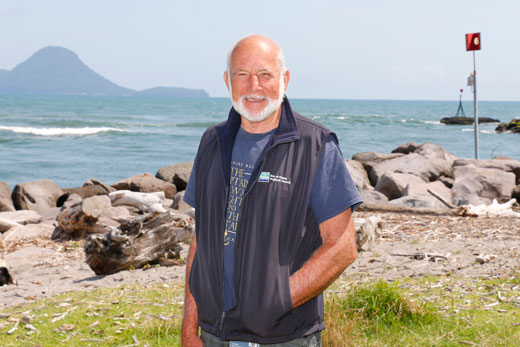
Champion of the reef fish – John ‘Tuna' Baker. Photo: Bruce Barnard.
John ‘Tuna' Baker, a hardened ‘old salt' with 50 years of fishing, diving and surviving White Island's moods says he should know – and it makes him melancholy.
'It's breaking my heart,” says John.
White Island (Whakaari), a heaving volcanic menace 55 kilometres off Whakatane is as ominous above the water as it is mind-blowing below.
The marine wonderland boasts spectacular visibility and is teeming with exotic fish species – banded perch, sawtail surgeon fish, coral trout, spotted sea bass and other species rare in our waters.
And there's the school fish, surface fish – maumau, trevally, mackerell, kingfish.
But John says that abundance, that uniqueness is its downfall – it's being plundered for the farmers' markets of Auckland. And he's watched it happen.
'I get a bit jealous and protective,” he says. 'After all I have dived on that site more than anyone and I hate seeing it abused and overfished.”
The threat of overfishing, John says, came with gillnetting.
'It's legal but it's immoral,” he explains, 'worse than purse seining or trawling.”
Gillnets are impenetrable panels of mesh, a ruthlessly effective method of fishing which is globally criticised for the amount of unintended catch it produces.
'There are literally acres of school fish around White Island (Whakaari),” adds john. 'Then you see them being gillnetted and shipped off to the weekend markets in Auckland.
'It is unbelievable. Gillnets can blow a reef away in a couple of weeks and ruin the experience for the next 20 years.”
They call gillnets the ‘wall of death' in Whakatane – and those who use them are vilified.
'Just a mention of gillnets and emotions run high,” says John. 'It caused a scrap between one of our charter operators and a gillnetter in a local pub. There was fisticuffs.”
‘Tuna' claims to have an intimate relationship and an understanding with White Island, and when he sees it being abused, he 'boils”.
Gazing out towards the smoking crater 50km from his balcony in Whakatane, the retired charter boat operator reflects on 10 years of politicking to successfully have the area designated a marine reserve.
'Then you see people out there fishing the reserve. Yes it does happen. That and gillnetting – my two pet hates,” he says.
The ‘reserve' is Te Paepae o Aotearoa – the Volkner Rocks – three dark and forbidding pinnacles jutting 112 metres from the sea and the 1267 hectares around them.
And just below the swell and the spume is a prolific and vibrantly colourful marine playground.
'It's a wonderful tourist attraction and gillnets should be banned within three kilometres,” he says.
To understand the man and his passion you have to understand the connection with his environment.
He is almost on first name terms with the fish.
John adds: 'A lot of trevally can be 40 to 50 years old – a red snapper is the same. I recognise them. I know one that's been living under the same rock for 20 years at least.”
He doesn't think ‘Joe Blow' understands how slow-growing and how ‘resident' a lot of these fish are.
John was so worried about the future of his beloved Te Paepae o Aotearoa marine reserve he even imposed his own quotas – one kingfish a day per person so 'nothing is over-fished”
But not everyone bought in. 'If you didn't belong to the charter fleet you weren't obliged to take much notice of the accord, and they didn't,” he says. 'They just don't care.”
'We have a minimum size of one metre, we don't take kingfish under one metre whereas legally the limit is 750mm. Those things have paid off over the years but unfortunately it doesn't protect any of the other stuff that is out there.”
And what of those elderly residents of Te Paepae o Aotearoa, like the venerable red snapper staring inscrutably from a crevasse of the reef?
'He should be protected – respected at least,” says the fellow old-timer of the reef, whose good work and opinions also demand respect.

0 comments
Leave a Comment
You must be logged in to make a comment.