


Bay of Plenty beaches might have come through the festive drowning season with an unblemished record, but now isn't the time to button off safety wise according to lifeguards.
Surf Life Saving New Zealand figures show that during the official Christmas holiday period, from 4pm on December 23 to 6am on January 5, five people have drowned on the nation's beaches.
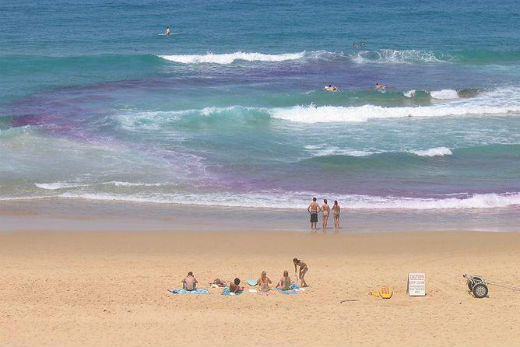
Purple dye in a rip at Dixon Park Beach in Newcastle, NSW illustrates the dangers of rips. Photo: Supplied.
Additionally, since the patrol season officially began on Labour Weekend, lifeguards have undertaken more than 300 rescues nationwide, with 70 of those taking place in December.
The essential rescue service has existed for over 100 years and the core message of swimming between the flags remains the same.
Omanu Surf Life Saving Club head guard Robert Sheard is urging the public to take practical steps to avoid danger in the water during what is the busiest summer on the beach in recent years.
'I don't have the exact figures,” says Robert, 'but since Christmas Day we have been pulling out at least four people every day. That's along the whole stretch of beach from Tay Street to Arataki.
'This year, more than ever in recent years, has been quite testing for us. It's been a busy season for us and the boys are going home having definitely earned their pay.”
Just yesterday Omanu lifeguards had to perform six rescues, with attributing factors including people out of their depth in the water, not knowing their swimming ability and getting stuck in rips.
Robert adds most of these incidents aren't life-threatening yet still require lifeguard assistance to get them back to shore.
And it is the recently publicised issues with rips sweeping along the coastline that continue to prove treacherous for beachgoers.
'The winter and recent storms just before Christmas left a bank meaning it was quite rippy,” he adds.
'So there is quite a lot of holes and rips developing, and even with the small surf it's been really quite treacherous conditions.”
Robert concedes not everyone can swim between the flags due to the large stretch of coastline, but where possible it is advised.
He says: 'We are urging people to swim between the red and yellow flags because that's the safest place on the beach. Outside of this we have had to do mainly 95 per cent of our rescues.
'But fortunately there are a lot of people, especially young familes and kids, which are swimming between the flags. That really does make a difference. It's the others that do swim between the red and yellows that are getting into trouble more often.”
Mount Maunganui Lifeguard Service general manager Glenn Bradley says the neighbouring club has been just as busy and, like Robert, wants swimmers to swim within the flags.
He says the area between Sutherland Avenue and Hart Street has been particularly busy with numerous holes and rips forming there on the change of low tide.
'In general I think the public have been pretty well behaved,” says Glenn.
SLNZ chief executive Paul Dalton says if people choose not to swim at a patrolled beach, they have to find out what risks they may be putting themselves, or their children, into and take practical steps to avoid them.
He adds in many cases, people underestimate the conditions and therefore the risks.
'What they perceive to be a safe place to swim isn't necessarily the case,” says Paul.
'Even waist-deep water can be life threatening if you step in a hole or get hit by a large wave.
'Conditions can also change very quickly and unfortunately, it only takes an instant for a tragedy to occur. If people aren't familiar with a beach, they should always ask the locals who have the knowledge before they go into the water.”

0 comments
Leave a Comment
You must be logged in to make a comment.