


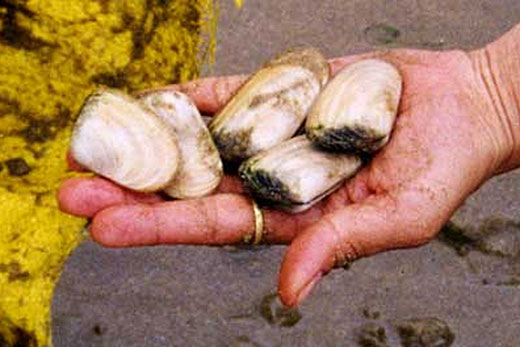
High levels of toxic algae has seen the popular summer dish of tuatua taken off the menu.
Toxin levels in Bay of Plenty shellfish are more than 20 times the level at which warnings are issued, and may still be rising, says MPI Principal Adviser Animal Products, Jim Sim.
Bay of Plenty and Coromandel shellfish are currently toxic.
'The last time levels this high occurred people ended up in intensive care,” says Jim.
Two years ago 30 people were poisoned and some ended up in intensive care.
So far this year 13 cases of toxic shellfish poisoning have been notified to the Medical Officer of Health with several admitted to hospital. They had all eaten shellfish collected from the Bay of Plenty coastline.
'Some members of the public are continuing to collect shellfish in the affected area, despite the risk,” says Jim Sim.
The area covered by the toxic shellfish warning was extended last week to include the entire coastline from Whakatane Heads in the Eastern Bay of Plenty, all the way along the coast to Waihi Beach, and up the eastern side of the Coromandel Peninsula to the river at the southern end of Whangamata Beach.
All harbours, estuaries and islands along this coastline are included in the warning.
The toxic algae species making shellfish poisonous is Alexandrium minutum, which produces the most toxic compounds of the various toxic algal species in New Zealand waters, Jim.
While it's not known what causes a toxic algal to bloom, Alexandrium minutum has a resting cysts stage which remain in an area after a bloom and, when conditions are right it, reappears.
Jim adds: 'This is why it occurs time and again in the Bay of Plenty area.”
The Ministry for Primary Industries is concerned holiday makers headed to the Bay of Plenty area are not aware of the high risk of getting paralytic shellfish poisoning from a feed of shellfish.
A health warning is in place advising against the gathering of shellfish from much of the Bay of Plenty coastline.
MPI collects and tests weekly water and shellfish samples from around the coastline of New Zealand to monitor shellfish toxicity so public health units can issue warnings when toxins are present.
Toxic algal blooms occur naturally and have been monitored routinely in New Zealand since outbreaks of poisonings occurred in 1993.
In the absence of rapid medical help, fatalities may occur and frequently do in other countries where medical help may not be available fast enough. Even with medical help, fatalities sometimes occur.
The public can obtain up to date information at www.ttophs.govt.nz/health_warnings MPI monitoring programme information at:
http://www.foodsmart.govt.nz/food-safety/hunting-collecting-fishing/seafood-gatherers/

2 comments
Cause may be Phosphorus
Posted on 24-12-2014 12:09 | By Willem
http://archimer.ifremer.fr/doc/00018/12901/9905.pdf Analysis of A. minutum blooms in the Penzé has shown that phosphorus, temperature and residence time are the main factors controlling A. minutum blooms, with light being less important and nitrogen being in excess in this ecosystem (Chapelle et al., 2008). What is the Council or the Ministry doing about excess levels of Phosphorus???
Poor nutrient Management
Posted on 27-12-2014 17:26 | By Dr Simon Tannock
I agree with Willem that Phosphorus is a most likely candidate for what drives a toxic algae bloom like this one. The more important issue is why there is a nutrient issue in our waters. Managing water on land, before it reaches the sea is essential. Not only because of the problems that occur when these nutrients reach the sea, but because harmful algae blooms occur in our freshwater as well. If we managed the water better, enhancing the useful algae to grow (the diatoms), then these nutrients would be absorbed by diatoms, and then eaten by zooplankton. But zooplankton don't like other algae as much as diatoms. Once those nutrients go into diatoms, then zooplankton, then fish, they don't allow harmful algae to bloom. Actively encouraging diatom growth is the best way forward if we want to manage our water into the future.
Leave a Comment
You must be logged in to make a comment.