


The resource consent application to leave what remains of the Rena on Astrolabe Reef will not proceed with direct referral to the Environment Court, the ship's owner and insurer have decided.
Instead, the application will be heard by independent commissioners appointed by the Bay of Plenty Regional Council – likely to take place in Tauranga in the first half of 2015.
Container debris from the Rena being retrieved. Photo: Supplied.
The decision comes after the Rena owner, insurer and project team visited Tauranga last month.
It also follows a review of the council's technical report, which outlines a number of conditions for consideration should consent be granted.
Captain John Owen of The Swedish Club, the Rena owner's insurer, says the current operation to remove cargo and other remaining debris that spilled on to the Reef when the vessel broke apart and sank is expected to go a long way to addressing many of the concerns raised by submitters, and in the council report.
He adds a number of submitters have expressed a view that going directly to court would limit the opportunity to have their say.
'The submissions highlight that the issues now remaining are matters for the local community,” says John, 'and it is appropriate that they are dealt with at council level.”
In September the regional council referred the application for resource consent to abandon the wreck of the Rena to the Environment Court.
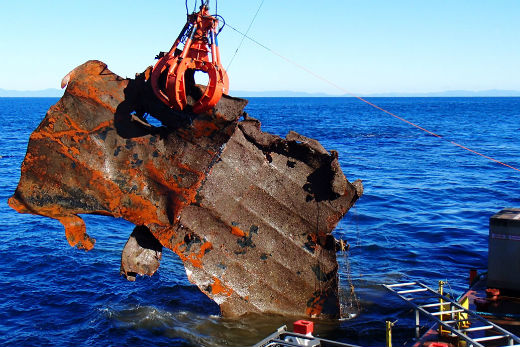
It was announced yesterday that phase two of the debris recovery operation is well underway, where as wellas the large hydraulic ‘orange peel' grab - a powerful electro-magnet - is now being used to recover smaller metallic cargo and debris, including lighter hull plate sections.
Roger King of TMC Marine Consultants says that after an initial settling-in period, the magnet has removed a lot of debris that the grab could not get.
'It doesn't get the large volumes, as the hydraulic grab does, but it does get ferrous material from around the rocks that the grab can't reach,” explains Roger.
'The salvors like working with it as the crane driver can pick debris with little effort and the riggers on deck like it as it only gets the ferrous scrap and debris, which means less time sorting non-metallic materials, but importantly less potential for damage to the reef.
'The thousands of steel balls we're recovering are a case in point – it would have been impossible without the magnet.”
Unsettled weather during November hampered recovery efforts and even when salvors do get out on the water, the rate of recovery has started to reduce considerably as many of the areas where they could access large deposits of debris have now been covered.
Since July this year, the total amount of debris recovered is now 2106 tonnes. Recovered debris has included significant quantities of container parts, scrap cargo, aluminium ingots, tyres, fibreboard and smaller quantities of wire.
Operations have also involved dive teams to aid in cutting more 547 tonnes of hull and bow structures for removal from shallow waters, which previously restricted the salvors' access to debris.

1 comment
JUST GIVE US OUR BLOODY REEF BACK.
Posted on 04-12-2014 15:21 | By CC8
Clean the place up and get over your lost money. It seems to me they are cutting away parts to weaken the structure so the bigger pieces will break up and move to deeper parts of the astrolabe reef. then they can claim it is more expensive and dangerous to recover them, thereby increasing the chances of obtaining a resource consent to leave them where they are.
Leave a Comment
You must be logged in to make a comment.