


One baby dying unexpectedly in its sleep is one too many says the leader of a programme focussed on reducing infant mortality.
'Thirty five New Zealand babies a year lose their lives to sudden unexpected death of an infant (SUDI),” says Bay of Plenty District Health Board child and youth mortality co-ordinator Raewyn Lucas.
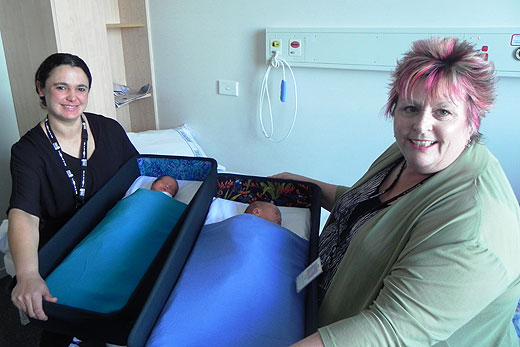
Safe Sleepers: Midwife Natasha Rawiri (left) and Child and Youth Mortality Co-Ordinator Raewyn Lucas (right) with six-day-old twins Tawhai and Te Atawhai Allen - who were born four weeks prematurely - in their new Pepi-Pods.
SUDI, formerly known as cot death, is the sudden and unexpected death of an infant during sleep.
In the Bay of Plenty there were 13 SUDI deaths between 2009 and 2011.
Intense work by a number of organisations - including the BOPDHB, Plunket and Te Kupenga Hauora – has resulted in fewer SUDI fatalities since.
'When a baby dies, the devastation and grief experienced by a family is profound and far-reaching,” says Raewyn.
Raewyn, who coordinates the Bay of Plenty Pepi-Pod Programme, says this year's national Safe Sleep Day, (Friday, December 5) is the perfect time to highlight safe sleep messages.
Risk factors associated with SUDI include co-sleeping, prematurity (less than 36 weeks gestation), low birth weight (less than 2500gm), tummy sleeping, sleeping on or near pillows, sleeping in car seats and slings (as chin-to-chest sleep positions cause a baby's airway to narrow and less oxygen to pass through) and smoking during and after pregnancy.
'A mother smoking during pregnancy reduces the amount of oxygen received by the growing baby,” says Raewyn.
'The baby gets used to that reduced oxygen level and its waking up response is impaired if it is given less air.
'In short, the baby has a decreased drive to breathe. Therefore its reaction in a situation where it is deprived of oxygen is not as quick as a baby which has not been smoke-exposed.”
The Bay of Plenty Pepi-Pod Programme began in June 2013 and has distributed over 300 Pepi-Pods (safe sleeping spaces for babies) to families identified as at-risk.
The programme has a trained workforce of distributors in Tauranga and Whakatane Maternity Units, led by midwife Natasha Rawiri and lactation consultant Sue Gulliver-Birkett.
'Our programme is all about education, care and support,” adds Raewyn.
'It's focussed on empowering parents to make the best choices to protect their babies while they are sleeping.
'It's a personal health message from us to the parent but when those parents share it with their friends and whanau it becomes a population health message. We have seen that in the Bay of Plenty.”
Two weeks after the initial visit to distribute the Pepi-Pod, one of the team contacts the family to see if it is being used and to encourage safe infant sleeping.
A further follow-up takes place after 8-10 weeks so parents can share their Pepi-Pod experience with the team.
'SUDI is commonly thought of as being associated with newborns but that's not always the case,” says Raewyn.
'Our data showed that babies up to 10-month-olds were still dying, so we need to be protecting these older babies as well.

0 comments
Leave a Comment
You must be logged in to make a comment.