


Billy Connelly's been diagnosed. The imperious Muhammad Ali's been humbled by it. Linda Ronstadt and Michael J Fox have got it.
Robin Williams, Johnny Cash, Pope John Paul…the list goes on.
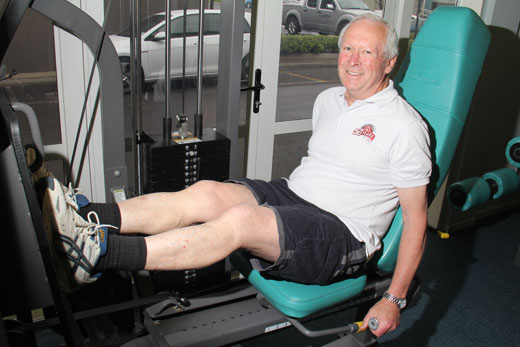
Tauranga man Neil Griffith keeps active, despite having Parkinson's disease.
And because Parkinson's disease is a great leveller, add Neil Griffith of Tauranga to that pantheon of celebrities.
Today marks the start of Parkinson's Awareness Week, and this is his story. He tells it not because he needs sympathy, but to assist our understanding of the disease.
'I feel more for you,” says the pragmatic engineer from Gate Pa, 'because it's you who has to put up with my tremors.”
He's been living with Parkinson's since 2005 – that's when Neil's astute daughter noticed her dad didn't swing his arms. It was a tell-tale sign.
But it was a noticeable tremor in his left arm that prompted a meeting with a neurologist.
'I remember the day clearly,” he says. 'He made me walk down the passageway a couple of times and then pronounced: ‘Yes - you've got it'.”
The ‘it' was Parkinson's, one of the most common progressive nervous system disorders. It starts with a small tremor but eventually effects almost every part of the body. There's no cure, but research is making advances every day.
'People don't die from it – they die with it,” quotes Neil. 'So that mean's one less serious thing to worry about.”
'You see pictures of Muhammad Ali and he is desperately ill with PD – well I prefer to take inspiration from the quote. Longevity has never been part of any discussion I've had on PD.”
The disease is caused by the progressive deterioration of neurons or nerve cells in the brain.
Normally, these neurons produce a vital chemical known as dopamine, which assists smooth and balanced muscle movement. A lack of dopamine results in a loss of ability to control body movements. Hence the tremors.
'People who know me know the tremor is part of me. So I don't let it get me down,” says Neil.
There is considerable controversy surrounding the possibility of a genetic cause of PD.
And there is also some evidence that certain toxins may cause Parkinson's disease; manganese, carbon monoxide and some pesticides.
Neil's father was in horticulture and therefore was probably exposed to pesticides.
'I used to go with him,” Neil adds. 'It's not proven – just a suspicion.”
Neil is a strong Christian – 'I certainly hope that helps me” – and he's dealing with a demon. He's quietly spoken but upbeat. Philosophical but frustrated. He has a wry smile.
He says: 'Some things you just can't do any more. I climbed a ladder and fell off. I played touch rugby with my grandchildren. My feet couldn't keep up with the rest of me. I ended up in A&E. Everyone laughed.
'But there are dark moments when you struggle to make things happen.”
He itemises the difficult aspects of PD; the typical stiffness and aches and how it's hard to get out of bed some mornings. The reduced ability to think things through – the most frustrating for someone with the clinical mind of an engineer, and how things take a lot longer to achieve.
He gathers himself and reverts to humour.
This pragmatic, self-employed professional man spends a lot of time sitting on his hands – literally!
Well one hand – when the tremors kick in under pressure or stress, he sits on the offending hand. After medication it's a sure-fire way to fix things.
Neil doesn't suffer from Parkinson's disease – he manages it.
For more information on Parkinson's Awareness Week, visit: www.parkinsons.org.nz

0 comments
Leave a Comment
You must be logged in to make a comment.