


A new treatment plant that collects waterblast and hardstand runoff from boats is being hailed as 'a revelation,” says the Whangamata Marina Society.
Whangamata Marina is the first in New Zealand to install the sophisticated treatment plant which has cost the society just over $1 million dollars to set up.
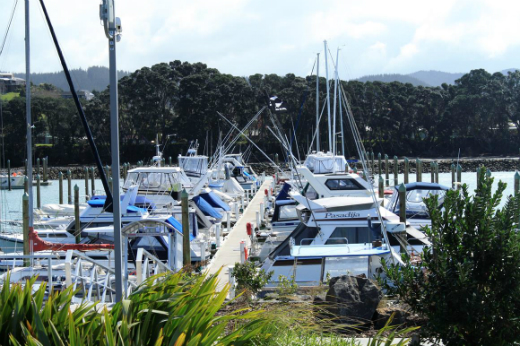
The Whangamata Marina. Photo: Supplied.
During one of its first runs more than 150kg of contaminated sludge was collected from 25,000 litres of treated water, of which 7000 litres was contaminated waterblast runoff.
The society's manager John Gillooly says essentially the batch was regarded as lightly contaminated but chemical trials were still being carried out.
'Our aim is to better the Waikato Regional Council resource consent standards, this won't be known until we have trialled a full load.
'There is no doubt that, until now, this material has been contaminating the sea.”
The plant aides the marina to keep its Clean Marina certification and all water collected on the hardstand runs through the treatment plant.
The process involves water from the hardstand collected in six catchment pits which, via sump, are then pumped into a 22,000 litre tank where it is aerated with material.
It is then pumped into an adjacent tank where the material is filtered out and moved into the chemical mixing tanks where lime, calcium hydroxide, polyaluminium chloride and a polymer are added.
The dosage of chemicals is determined by the volume of material to be treated and its perceived level of contamination.
Clear treated water is then drawn off and discharged at a measured rate to the sewer or sea, while clumps of sediment is drawn off and forced through a multi plate press at up to 100 psi.
The resulting material is then compacted into cakes and sent to a landfill that caters for this type of material.
John says to get the plant up to standard some redesign of the construction drainage and catchment areas were necessary.
This included constructing another large catchment pit, pumps, three additional catch pits, another large sump and electrics which make the system almost fully automatic.
'Shut off valves have also been installed allowing the yard to be shut off into three sections.
'The catch pit at the bottom of the yard also has a sediment trap and is the section which most of the dirty work is concentrated.”
BREAK DOWN OF COSTS TO THE WHANGAMATA MARINA SOCIETY:
$220,000 - ground works and drainage
$130,000 - building, pits and bunds
$500,000 - the plant, pumps, electrics, tanks, pipe work, press, compressor
$200,000 - consultancy, surveys and permits

0 comments
Leave a Comment
You must be logged in to make a comment.