


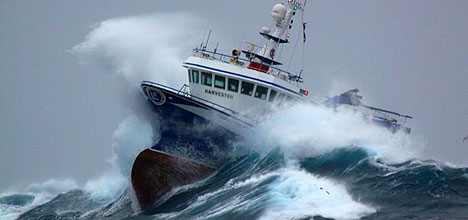
This is the time of year when you can expect changeable and squally weather. If you're going out on the water fishing over winter, it pays to run through your mental checklist before you leave.
Check the forecast
Check the latest weather forecast before you set out – in this part of the world, the weather can be unpredictable and changeable, especially in spring and autumn. Use your local knowledge and apply it to the forecast to give you some idea of what you can expect. For instance, I know that where I live at the Mount, when MetService is forecasting showers in the Bay of Plenty, there will certainly be showers up in the surrounding Kaimai ranges, but we will hardly ever get any rain at the Mount. Conversely, it is almost always windier at the Mount than it is at Tauranga and further inland. Local knowledge will be invaluable in interpreting the weather forecasts.
Know your boat
Even if you check the forecast, sooner or later you may get caught out in nasty conditions. A sudden squall or change of wind direction can give you an exciting ride home however if you're unlucky – or unprepared – it can all turn pear-shaped. Knowing how to handle your boat in rough conditions can make all the difference between exhilarating and terrifying.
Handling big waves
Flying off each wave can be fun but it is very tiring for you and your crew. It's easy to damage someone: the G-forces can be as high as 14G according to recent research. Make sure your crew all have something secure to hang onto and the helmsman is wearing the kill-cord.
Heading into it
If you're travelling into the wind and waves, ease off the throttle at the top of the waves to avoid becoming airborne. Accelerate down the back of the wave and speed up in the trough to make some headway. This should help to lift the bow up the next wave, then ease off again as you pass over the crest. You will need to keep working the throttle up and down, with every wave.
A quick rule of thumb is: when the bow is rising, throttle on; when the bow is falling, throttle off. Adjust your speed enough to reduce slamming into waves as much as you can. If the wave crests are very close together, you might find it more comfortable to zigzag across the waves at 30 to 45 degrees. Although this increases the distance, it can allow you to travel faster and in more comfort. You will need to experiment a bit, as each boat behaves differently in different wind and sea conditions.
Side-on or beam seas
Large breaking waves from side-on have the potential to capsize your boat. Keep a close watch on the waves as they approach. If you get caught out with a large breaking wave approaching from the side, you have to decide whether to turn and steer into the wave, powering on the throttle to climb up the breaking face of the wave; or to turn and run before it and try to outrun the wave. The circumstances may dictate which course of action you choose.
Travelling downwind
Travelling in the same direction as the waves can be one of the most dangerous conditions for any boat. Breaking waves are full of water mixed with air and we all know that air won't support your boat. Your prop can't 'bite” in air and your rudder can't steer in air either, so if your boat gets caught in breaking and aerated waves, be prepared for your boat to become unmanageable. The likely outcome is that your boat will slew to one side and broadside down the face of the wave. If you can't regain control and straighten the boat up before the next wave arrives, you will get caught side-on to the next wave and capsize.
The best option if you get caught travelling the same direction as breaking seas is to match your boat's speed with the speed of the wave and ride the back of the wave. Alternatively, pick a calm patch to turn into the breaking waves and look for another destination.
Wind against tide
When the wind is blowing in the opposite direction to the tide you get short, steep and lumpy seas. A harbour entrance that was calm when you left for a few hours' fishing can quickly become nasty when the tide turns. It helps to know your local area and to know what time the tide turns. Talk to your local coastguard, boating club or harbour master for more information.
Safe boating and be winter weather wise!

0 comments
Leave a Comment
You must be logged in to make a comment.