


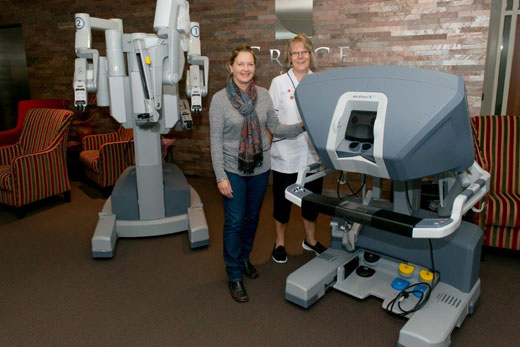
Grace Hospital's latest acquisition, a multi-million dollar surgical robot, is lifting the hospital's keyhole surgery to a new level.
Hospital staff and surgeons have been keenly anticipating the arrival of the da Vinci Si robot, increasing the range of surgical procedures available to patients, both from Tauranga and further afield.
Grace Hospital general manager Janet Keys with a hand on robot Si, and nurse Sharon Rendell.
The purchase of the new Si robot reinforces Grace Hospital's position as New Zealand's foremost centre for robotics.
Grace Hospital general manager Janet Keys says the Si robot from Intuitive Surgical, USA, is a sizeable investment for Grace Hospital, costing close to $3 million.
'But this latest technology means we're right up with rapid advances in the field, and takes us to another level,” says Janet.
'It will allow our surgeons to expand on the current urological, gynaecological and other abdominal procedures.”
Robotic-assisted surgery is deemed a minimally invasive method of performing surgery.
A surgeon's hand movements are translated through the robot to miniaturised instruments inserted into small 'keyhole” incisions in the patient's abdomen, says Janet.
A high-definition 3-D camera guides the surgeon during the procedure.
'This technology gives the surgeon greater precision and control, and reduces the potential for blood loss or damage to tissues.”
Janet says patients who have such minimally invasive procedures are likely to lose less blood and have less post-op pain, and smaller scars. It also means is a faster recovery than with traditional open surgery.
'So with less visible scarring, procedures done with the Si robot have lots of appeal to people who want a better cosmetic result.”
'The stay in hospital is usually shorter so the patient can be back at work, and enjoying recreational activity, faster.”
Surgeons receive specialised training in the use of the robot, and the Si incorporates a surgery simulator module. This means that surgeons can be trained at Grace Hospital before travelling overseas for further advanced robotic surgery training.
Janet envisages that surgeons and robotic surgery assistants from around New Zealand will utilise the simulator to complete the first part of their training.
After an extensive commissioning process, the Si robot will be available for its first procedures in June. Current procedures carried out with the robot are prostatectomies for prostate cancer, kidney modifications and some bladder procedures.
'In the near future, hysterectomies will be able to be performed once one of our local gynaecologists completes his training programme.”
Grace Hospital was the first hospital in New Zealand to perform robotic surgery in 2007, and a team has been performing surgery with robotic assistance since then.
Hospitals in Auckland and Christchurch also have surgical robots, but in view of the experience Grace surgeons have gained, many patients travel to Tauranga for their procedures.
The new robot is replacing an older model whose technology has been superseded.

0 comments
Leave a Comment
You must be logged in to make a comment.