


Tauranga microbiologists are advising people to change their health habits to help reduce the risk of spreading ‘superbugs' already present in the Bay of Plenty.
Bay of Plenty Pathlab clinical microbiologist, Michael Addidle, says there are a few areas of concern to antibiotic resistance in the Bay, despite relatively stable rates in the last 10 years.
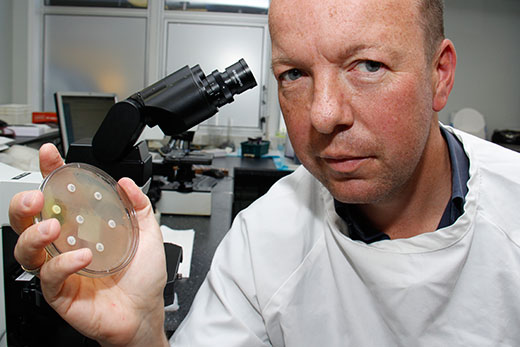
Pathlab clinical microbiologist Michael Addidle showing a plate with resistant bacteria.
This week the World Health Organisation announced that antibiotic resistance will become a bigger threat than AIDS in the next 10 years.
It warned that resistance to superbugs – an antibiotic resistant bacteria potentially fatal to people who contract them – is growing globally and NZ cannot escape it.
Michael says the most common superbugs Pathlab sees are Methicillin-Resistant Staphylococcus aureus, or MRSA, and EPLs - Extended Spectrum Beta-Lactamase producing bacteria that can have serious consequences.
'Each of these causes a handful of serious invasive or bloodstream infections in the local population each year.
'However, we are fortunate here in that even with these bacteria in the local region, we still have other antibiotic options available.”
New Zealand still has relatively low rates of antibiotic resistance, but all known strains of superbugs are present throughout the country – including the Bay of Plenty, says Michael.
'MRSA rates have risen slightly over the past 10 years, by 2-3 percent.”
There is a significant increase in resistance by the bacteria which causes gonorrhoea to the antibiotic ciproflaxin 'making this antibiotic effectively redundant as an empiric treatment option for gonorrhoea,” says Michael.
Michael advocates common sense measures.
'Good hand hygiene is important in minimising transmission of resistant bacteria. Prudent use of antibiotics- reserving them for when they are genuinely needed is essential.
'It is also important that if you have been in a hospital overseas recently and then end up in a hospital back here, that you let the medical staff know so that they can then screen for resistant bacteria.”
Microbiologist and recipient of the 2012 Prime Minister's Science Award for Media Communication, Dr Siouxsie Wiles, says WHO's report highlights what clinicians and microbiologists have been saying for years.
'Resistance is widespread and in 10 years we could be back in the pre-antibiotic era, where a stubbed toe could be deadly.”
In Siouxsies's opinion people need to start listening to doctors more to try to reduce the incidence of these 'superbugs”.
'Kiwi's need to accept when their doctors tell them they don't need antibiotics for their cold; finish their course of antibiotics if prescribed; get themselves and their children vaccinated; and pressure the government to fund research into the development of new antibiotics and alternatives to antibiotics for killing microbes.”
Siouxsie says that infectious disease research is seriously underfunded and that Kiwis could 'perhaps consider running the odd marathon to raise money for infectious diseases research”.
Siouxsie's concerns are echoed by Environmental and Science Research clinical microbiologist, Dr Debbie Williamson, who says 'antimicrobial resistance is arguably one of the biggest man-made public health threats of modern times, and similar to other settings, New Zealand must confront this challenge”.
Debbie highlights MRSA and drug resistant Tuberculosis as some major threats to New Zealand. MRSA prevalence has doubled in New Zealand from 2003-2012.
'It is imperative that, in the face of the threats and realities of antimicrobial resistance, New Zealand builds on existing linkages and infrastructure, and adopts a cohesive, pro-active and multi-regional approach that combines expertise from across the medical, academic, and veterinary sectors.”
So how can Kiwis prevent the spread and rise of antibiotic resistant bacteria?
Infection Control consultant for Henry Schein Shalfoon, Megan Sharpe, suggests a 'back-to-basics approach”.
Hand washing and cleaning down surfaces are a must. Megan says don't just use alcohol rubs – 'they're not a magic clean bubble, we need to pre-clean, then use disinfectants”.

0 comments
Leave a Comment
You must be logged in to make a comment.