


New Zealand can expect hotter temperatures, more rain and more days of extreme fire risk, according to the latest United Nations report on human–caused climate change levels.
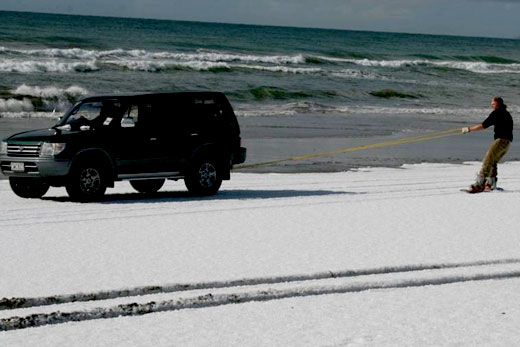
EXTREMES: A boarder enjoys the result of a hail storm at Papamoa Beach in 2009.
The Intergovernmental Panel on Climate Change report known as the Fifth Assessment Working Group 2 report, includes an Australasian chapter for the first time with input from Niwa climate scientist Dr Andrew Tait, AgResearch scientist Dr Paul Newton and New Zealand Agricultural Greenhouse Gas Research Centre scientist Dr Andy Reisinger.
They say New Zealand continues to demonstrate long term trends toward higher surface air and sea-surface temperatures, with more hot extremes and fewer cold extremes, and changed rainfall patterns.
The full Working Group 2 report, released today, assesses impacts, adaptation and vulnerability related to climate change, and has been prepared by a team of leading climate scientists from around the world, who have assessed the latest research from thousands of scientific papers.
It follows the release of the Working Group 1 report last September, which declared human influence on the climate system was unequivocal.
'The Working Group 2 report highlights where we are already seeing signs of climate change impacting on our environment and societies, and predicts what the impacts are going to be as our climate continues to be affected by ever-increasing concentrations of CO2 and other greenhouse gases in the atmosphere,” says Dr Andrew Tait.
'The report is a chance to re-state and re-emphasise the climate change vulnerability and adaptation issues that we face, and for us to say that the impacts of climate change are not going away,”
'It also provides a comprehensive understanding of the current state of science in relation to climate change.”
The Australasia chapter covers a range of climate change projections, impacts and adaptation options.
Climate and Sea Level:
Warming is expected to be associated with rising snow lines, more frequent hot extremes, less frequent cold extremes and increasing extreme rainfall related to flood risk.
Annual average rainfall is expected to decrease in the north-east South Island and northern and eastern North Island of New Zealand, and to increase in other parts of New Zealand.
Regional sea level rise will very likely exceed the historical rate (1971-2010), consistent with global mean trends.
Water resources:
Precipitation changes are projected to lead to increased runoff in the west and south of the South Island, and reduced runoff in the north-east of the South Island, and the east and north of the North Island.
Annual flows of eastward flowing rivers with headwaters in the Southern Alps (e.g. Clutha, Waimakariri, Rangitata) are projected to increase in response to higher alpine precipitation. Most of the increases occur in winter and spring, as more precipitation falls as rain and snow melts earlier.
In contrast, the Ashley River, slightly north of this region, is projected to have little change in annual flows, with the increase in winter flows offset by reduced summer flows.
The retreat of glaciers is expected to have only a minor impact on river flows in the first half of the century.
Flooding
Flood damages across New Zealand in 2010 and 2011 revealed a significant adaptation deficit.
Flood risk is projected to increase in many regions due to more intense extreme rainfall events driven by a warmer and wetter atmosphere.
50-year and 100-year flood peaks for rivers in many parts of the country will increase (with large variation between models and emissions scenarios), with a corresponding decrease in return periods for specific flood levels.
Flood risk near river mouths will be exacerbated by storm surge associated with higher sea level and potential change in wind speeds.
Wildfire
Climate change is expected to increase the number of days with very high and extreme fire weather in many, in particular eastern and northern, parts of New Zealand.
Fire season length will be extended in many already high-risk areas and so reduce opportunities for controlled burning.
For the full report see: www.ipcc.org.ch
The IPCC view on climate change is under concerted attack by scientists who say the available evidence does not support the theory.
In a paper published in February Dr Gerrit J. van der Linden's paper titled Global Cooling argues the sun is diminishing its energy output and earth may instead be cooling.
Global temperature records are published by three organisations, the UK Hadlee Centre, NASA's Goddard Institute for Space Studies (GISS), and NOAA's National Climate Date Centre (NCDC).
On January 21, 2014, Gavin A. Schmidt, Deputy Chief, NASA's GISS and Thomas R. Karl, Director of NOAA's NCDC, jointly announced that their temperature records showed zero net global warming since 1997. The UK Met Office confirmed that their newly revised HadCRUT4 global temperature dataset (from the Hadlee Centre) also showed zero net global warming since 1997.

3 comments
climate
Posted on 31-03-2014 20:42 | By dumbkof2
hello the climate soothsayers are at it again
Theodorus
Posted on 31-03-2014 21:57 | By Theodorus
If we are not careful one day we may be finishing up in hell any way!
links
Posted on 01-04-2014 11:58 | By wazzock
I can't find your referenced Global Cooling paper anywhere - is there a link please?
Leave a Comment
You must be logged in to make a comment.