


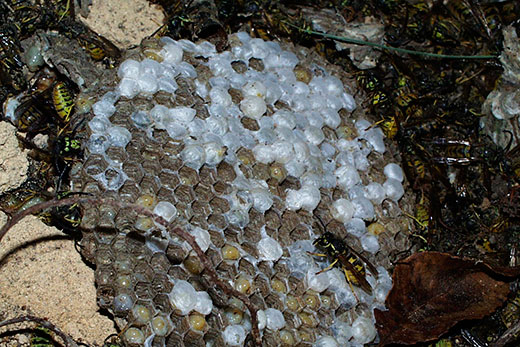
Home gardeners in the Bay, and anyone using sprays this autumn, are being asked to make sure they are bee and butterfly friendly – to help in the battle against wasps.
Federated Farmers president Bruce Wills says advises Bay residents to use these sprays because they won't hurt ladybirds, which prey on wasps, with numbers of stinging insects increasing dramatically this summer.
High wasp numbers this summer are prompting advice to be given to Bay gardeners to use bee and butterfly-friendly sprays so ladybirds can hunt wasps.
'If you are a home gardener then please buy chemicals specifically labelled bee or butterfly friendly, because it will be ladybird-friendly – and we need every ladybird possible,” says Bruce, who is plagued with wasps on his Hawke's Bay farm.
Some are linking the explosion in wasp numbers to the arrival late last year of a new pest to New Zealand, the giant willow aphid, which excrete honey dew that wasps like to feed on.
The aphids are already well established in the Bay of Plenty, with Omokoroa orchardist Neil Brough finding thousands on his kiwifruit orchard in early-February. Following SunLive reporting on Neil's dilemma, his neighbours are also reporting infestations.
While the giant willow aphid insect rapidly disappeared from Neil's orchard, this pattern is normal as it prepares to over-winter – and is likely to be back in large numbers in spring.
By the time the Ministry for Primary Industries became aware of the giant willow aphids late last year, the insect was too widespread throughout the country to make eradication feasible, says an MPI spokesperson.
Bruce says while ladybirds love eating aphids, it will take years for their population to grow large enough to get the giant willow aphid under control.
The aphids may not the only reason for the increase in wasp numbers, with Bruce predicting the mild winter could have meant more wasp nests than usual survived, giving the population a larger base to start from.
It sounds unlikely, but the New Zealand green-lipped mussels might also hold the key to helping control wasp numbers.
Scientists at Plant and Food Research have been trying to identify new ways to control wasps using baits in beech forests, where the insects have a detrimental effect on native fauna. However, the breakthrough came while two members of the research team were on a fishing expedition.
'We couldn't help noticing how attracted the wasps were to the mussels we were using as fish bait,” says project leader Dr Ashraf El-Sayed. 'Being scientists, we looked into it.”
The research team, including visiting professor Rikard Unelius from Linneaus University in Sweden, investigated the smell produced by the mussels and identified a mixture of compounds highly attractive to the wasps.
The team believe these compounds could form the basis for a new generation of control methods for wasps.
'Vespid wasps are highly abundant in New Zealand's indigenous beech forests, due in part to the vast supply of honeydew, which is also a major food source for native birds and insects.
'Traditionally, wet cat food has been used as bait, but this degrades rapidly and has to be replaced often.
'By identifying new compounds that attract wasps, we can control them more effectively. Using compounds from New Zealand mussels may provide a sustainable method for controlling these insect invaders.”
The research is published in the ‘Journal of Applied Entomology' and funded through the Ministry of Business, Innovation and Employment.

1 comment
i
Posted on 22-03-2014 23:23 | By Capt_Kaveman
found the numbers less this year but in that every nest i find gets instantly destroyed
Leave a Comment
You must be logged in to make a comment.