


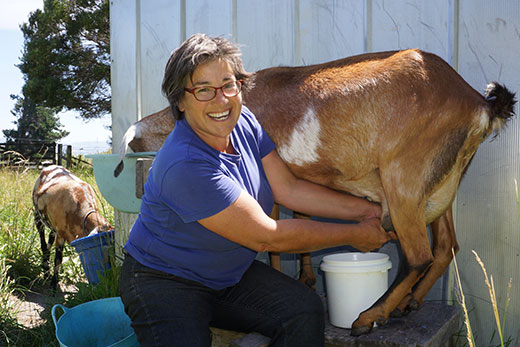
When paediatric nurse Julie Nicol thought she'd like to make cheeses, she bought some milking goats then borrowed library books to learn how to take care of them as well as the art of cheese making.
Julie Nicol enjoys milking Petal, the Anglo-Nubian goat; and turning her rich milk into cheeses. Photo by Ross Brown.
'It was a steep learning curve, as I got the goats before I had all the fences in place and I lost many trees to their browsing.”
Today Julie produces a range of soft and hard cheeses from the milk of her Anglo-Nubian goats, which graze on her half-a-hectare of land at Kina in the Tasman District.
'The Anglo-Nubian goats are quite rare in New Zealand; and their very creamy milk with a high fat content means it is ideal for cheese making.”
Julie, who has lived in big cities for most of her life, considers herself a ‘townie', but says she fell in love with the rural lifestyle when she visited a friend in the Tasman region.
'I thought the area was magic; and [I] had an immediate sense that this was where I wanted to live.”
The decision to buy a piece of land was quite a change of direction for Julie, who had spent two years nursing in Saudi Arabia prior to settling in Tasman.
But it's a decision she has no regrets about making.
She is still nursing in Nelson and fits once-a-day milking of Petal around her shifts.
Petal is the only goat in milk at present; and after she's been milked, her kid Lavender spends some time with her and the other goats Rosebud and Lilly.
From Petal's milk Julie can make feta, haloumi, brie, blue cheese and hard cheeses which she enjoys eating and sharing with friends and family.
There's no shortage of milk as Petal can produce up to five litres of milk a day and is quiet and easy to milk.
Julie admits to spoiling her goats, which not only have shelters to keep them warm in winter and cool in summer, but also receive a daily ration of hard feed made up of a mixture of lucerne hay, clover hay, goat pellets, bran, garlic, molasses, cider vinegar, seaweed meal and minerals.
'Anglo Nubian goats are not as hardy as some breeds and do need extra care. They need to be kept warm, as they don't have thick coats like the Swiss breeds, and are susceptible to worms. I do drench them when I need to because they don't cope with stress very well, such as that caused by giving birth. 'They need their feet trimmed too, but they are lovely goats to have.”
The goats share their home with two kunekune pigs, chickens, a cat, a dog and Julie's horse, which grazes the property. Julie has a big garden and orchard to tend as well.
'It is amazing to have all of these animals in my life; it has been crazy, so much fun, and they have taught me so much about life,” says Julie, who loves the Tasman district.
'I can walk to the beach and I look at the mountains every day out of my windows.
'This is a truly beautiful place; I feel it is such a privilege to live here.”
#The Anglo-Nubian goat breed was originally developed in England by crossing traditional milking goats with those from Africa and the Middle East. They have large, long ears and what is often described as a ‘Roman nose'.

0 comments
Leave a Comment
You must be logged in to make a comment.