


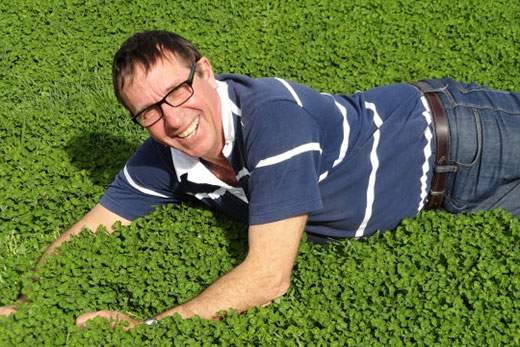
Doug Avery, the Marlborough farmer brought almost to ruin by drought, no longer worries about the weather.
Marlborough sheep farmer Doug Avery, in a paddock of lucerne.
'I spend my time thinking about things I can influence in my business,” says Doug, who people call ‘The Drought Man' and ‘The Lucerne Man' for the dramatic change he made from grass to lucerne pastures in an effort to save his family farm.
It wasn't easy, but the turnaround in the farm and Doug's own thinking has been so impressive, he's been sharing his story with farmers nationwide the country through his ‘Beyond Reasonable Drought' workshops.
'If you run a corner dairy, a swish car yard, farm or a hotel in Queenstown, the principles of business are the same,” Doug told Coast & Country.
'What happens with farmers is they work in isolation, and they get occupied in stuff that isn't going to help them in their future.”
Dramatic
'I call that their areas of concern. When I stopped wasting my time on my areas of concerns, and started looking at the dot inside the big circle of concern, called your circle of influence, my life started to change dramatically.
'A lot of my talk is around these sorts of strategies – and that applies to dairy, beef, sheep, deer, goat – any farmers – and the service industries that support them.
Doug says people leave his seminars they don't leave talking about lucerne; they're talking about thinking about themselves.
'My message is about change; and a lot of people just don't understand what the steps are.
'I didn't either at first; I went through them, and change is hard,” says Doug, who is 2010's South Island Farmer of The Year and 2013 Landcorp Agricultural Communicator of the Year.
In 1998, a depressed and disillusioned Doug had just about given up on his 1500ha farm.
Years of prolonged droughts had Doug and his wife working endlessly, unable to pay the bills and feed their family off Bonaveree – the farm in their family's ownership since 1919.
'It had got to the point when I realised this has gotten beyond a joke. We had the driest decade since records began; and it was a desperate battle for survival.”
In desperation, Doug attended a field day where professor Derrick Moot spoke about lucerne.
'That hour changed my life,” says Doug. 'He promoted the concept of using lucerne as a primary grazing plant, when we had a ryegrass and clover-based system.”
Knowing change was the only option, Doug took a risk and during the next four years implemented Derrick's theory on his farm.
'Things got worse before they got better; I was doing it in isolation and had no support. The only reason I kept going is I knew the road I'd been travelling was no longer a viable option.”
Doug and his family changed their entire farm process – an effort not received well by the farming community.
Lunacy
'They called me the ‘Lucerne Lunatic', they said: ‘The man's gone crazy'. But few people would call it lunacy now.”
From 2008-2010, Bonaveree's performance doubled. And it has doubled again since then.
For every drop of water his farm receives, Doug gets twice the energy from the water that a typical grass-land farmer would. Doug's lambs fatten at 400 grams per day – significantly more than the national average of 178g. In 2002 Bonaveree had 3700 sheep and produced 25 tonnes of meat – in 2012 with 500 more sheep the farm, it produced 85 tonnes of meat.
'I have huge gratitude to the system and processes that saved my life. There was a lot of emotion and heartbreak tied up in those terrible years; and I'm so scared of ever returning to that place again.”
At age 59, last month Doug undertook a mission to spread his message of success.
'I want to live in a country with higher wealth and wellbeing for its habitants. I want to be personally involved in taking NZ agricultural systems to a higher and better place.”
Legumes
Doug says he had no choice, 'being at the end of the barrel”, but to adopt change. 'I believe the changes we went through are relevant to a huge number of farmers – I enjoyed putting them out there in workshops – and obviously, people are interested in that process.”
Doug says his fascination is legumes – not just lucerne.
'I'm pushing legumes because they fix nitrogen naturally. Legumes effectively double the value of water, in terms of its ability to produce basic elements, like soil fertility and water into dollars. 'Lucerne, if you can grow it, is the most effective one.”
Doug says growing the plant, you do run into problems because they're different. 'For a lot of people, because they require a different approach, they back off and go back to grass.
'In NZ's case we still need nitrogen, so we put it on artificially; and my drive – with my farm performing in the top five per cent in one of most difficult and dry areas of the country – is I've found a way to do this stuff and as a natural part of the farm.”
To learn more about Doug, visit www.beyondreasonabledrought.co.nz

0 comments
Leave a Comment
You must be logged in to make a comment.