


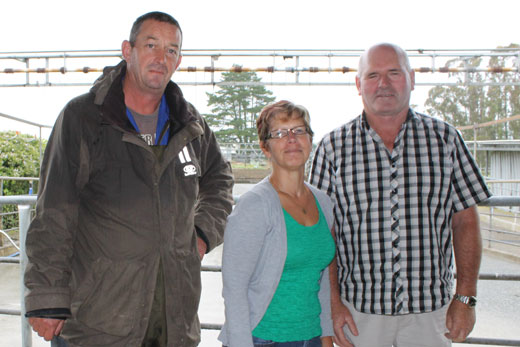
Consultation and co-operation achieve far more for the environment than confrontation, believes Trevor and Harriet Hamilton.
Andrew Truscott manages Rere Farm for Trevor and Harriet Hamilton and T H Enterprises.
A prime example of consultation at its best is Project Rerewhakaaitu, say the Hamiltons, who are part of the scheme. It was launched by farmers in the lake's catchment about 13 years ago to preserve the lake for future generations.
Landowners work closely with the Bay of Plenty Regional Council; and today the lake's waters are among the cleanest in the district. Trevor says the unique form of co-operation rather than imposed regulation has proved it is possible to intensively farm in the lake catchment without contaminating its waters.
Project Rerewhakaaitu is an important model for how to care for the environment – but, says Trevor, it's also an illustration of how to retain investment in farming. 'While as a country we have to look after our environment, we also have to be careful that regulation to do so doesn't drive investment offshore. We are strongly focused on NZ Inc and by choice would always prefer to invest in this country, not overseas.”
However, if draconian regulations were in place for farming around the lake, Trevor says it's unlikely the family business would be interested in farming there.
It's not that the business doesn't have regard for the environment, it's because the Hamiltons believe more can be achieved; and the outcomes are better when issues are handled in a collaborative manner and farming is financially sustainable.
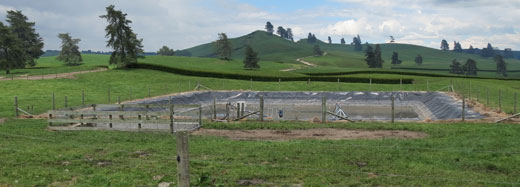
Investment has been made to manage dairy effluent so it doesn't impact on Lake Rerewhakaaitu.
Beginnings
Trevor and Harriet are principals in T H Enterprises, a venture which traces its beginnings back 36 years to their early days as farm workers and then sharemilkers. As they raised five children (including twins), milked cows and saved hard for the next step up the ladder, their aim was to provide for themselves and give their children a better lifestyle and education opportunities than they or their parents experienced.
They didn't initially envisage, back in the 1980s, that their aspirations would eventually lead to a company which today owns eight farms with 1458 effective hectares, milking more than 6000 cows and employing 38 staff. Three of the farms are in the North Island and four in Canterbury. Four of their five children are employed and have a shareholding in the business.
It's Rere Lake Farm Ltd, which has been entered in the Ballance Farm Environment Awards. It is a 146 ha dairy farm milking 585 cows, which produced 252,882 kg/ms in the 2011-2012 season and 215,654 kg/ms last season, despite the drought.
Like many entrants, Trevor and Harriett had to be convinced to enter. 'I didn't think our farming business fitted the requirements of the awards, as I don't see us as ‘greenies'.
'Our focus is on being sustainable across all aspects of our business; and that does include the environment, but not the exclusion of being profitable. You have to be financially in the black to be environmentally green.”
However, the Hamiltons fully recognise that to be able to farm the land in perpetuity and remain sustainable as a business, the environment must be cared for.
'We've taken a lesson from Maori trusts and their attitude to land ownership. We have no intention of selling and take the long term view of the land.”
The scale of the Hamilton enterprise does make it easier to be 'green”. 'We have access to capital which can be allocated to projects, including to protect the environment, where it is required which is something many farm owners don't have the luxury of,” says Trevor.
Trout
Like other farmers in the Rerewhakaaitu catchment, the Hamiltons have adopted a range of measures to reduce the impacts of their farming on the lake. These include fencing out the trout spawning Mangakino Stream, which runs through the property. Work has been done to reduce runoff from a bridge and the approach laneways associated with crossing the Awaroa stream.
Nutrient budgeting is done annually with AgResearch and Ballance; and GPS is used for tracking of fertiliser spreading and recording. The farm has a very good nitrogen-conversion efficiency and good timing with smart use of N-products especially in high risk periods.
Rere farm is managed by Andrew Truscott and he follows protocols set out for all the company's farms, which includes a 'no thirsty or hungry days for stock” standard. Meeting that standard was testing during last summer's drought and that was when Trevor, who aims to leave day-to-day decisions to his staff, played a more hands-on role.
'It was a tough for staff, as they hate to see cows hungry. They needed more support and direction from us in how to manage feed during that time, and an assurance that we would not dry off [cows] early nor put off staff, when other farms were doing so,” says Harriett.
Andrew and the Hamiltons are fully aware that they are farming in a particularly sensitive catchment and take a strong ‘ownership' attitude towards the local lake and protection of its water quality.

0 comments
Leave a Comment
You must be logged in to make a comment.