


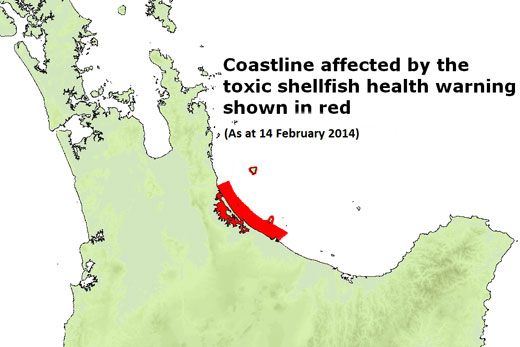
Shellfish warnings have been lifted for all Bay of Plenty beaches except for those in the Western Bay from Waihi Beach to Maketu.
Regular monitoring is showing Paralytic Shellfish Poisoning levels are falling along parts of the Bay of Plenty coastline.
The current area affected by toxic shellfish.
'There is now no PSP concern from Pukehina eastwards,” says Medical Officer of Health, Dr Phil Shoemack.
'However, the current warning remains in place from Waihi Beach to the northern end of Pukehina.”
The warning against gathering or eating shellfish includes Tauranga Harbour, Maketu and Waihi estuaries, Matakana and Motiti Islands, and all other islands along this coastline.
The health warning applies to all bi-valve shellfish including mussels, pipi, tuatua, cockles, oysters, scallops as well as cat's eyes, snails and kina (sea urchin).
PSP is caused by natural toxins that are produced by algal blooms and accumulate in shellfish that feed on the algae.
Shellfish containing toxic levels of paralytic shellfish poison don't look or taste any different from shellfish that are safe to eat. Cooking or freezing the shellfish does not remove the toxin. Paua, crayfish and crabs can still be taken but as always, the gut should be removed before cooking or eating.
Eating shellfish affected by paralytic shellfish toxins can cause numbness and tingling around the mouth, face, hands and feet; difficulty swallowing or breathing; dizziness; double vision; and in severe cases, paralysis and respiratory failure.
The symptoms can start within one or two hours of eating toxic shellfish and usually within 12 hours. Anyone suffering illness after eating shellfish should seek urgent medical attention.
Monitoring of toxin levels will continue along the coast and any changes in advice will be communicated accordingly.

0 comments
Leave a Comment
You must be logged in to make a comment.