


Maize, being a sub-tropical plant, requires a certain number of heat units for the crop to reach maturity, with fully loaded kernels of starch-rich cobs in time for harvest.
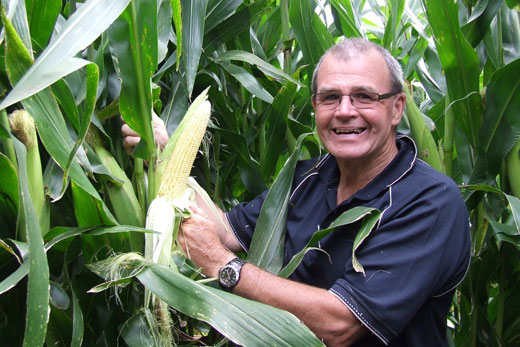
Barry Smallridge of Pacific Seeds with a healthy maize crop ripe for making silage.
Corn hybrids can differ in their requirements for heat and sunlight for maximum yield. Early maturing plants, which require less heat than longer maturity options, had finished tasseling and silking about mid-January. This period is when the plant requires the highest level of moisture uptake, in fact, during this three-week period the plant needs 35 per cent of its total moisture requirement.
Most regions are ahead of their yearly rainfall average. However, early last month some areas, for example Morrinsville and Dargaville, were behind their averages, while Hamilton and Whangarei were slightly ahead of their yearly average.
With sufficient rain combined with the growing degree days being above the average, it's therefore not surprising to see many maize crops this season looking as healthy and advanced as they have done for a number of seasons.
Growing Degree Days, or GDD, is calculated on an accumulation of heat normally measured during a 24-hour period, culminating in a measurement from planting to maturity.
Where crops are inconsistent in height, this is a result of de-nitrification which occurs when excess moisture has remained on or near the surface and has not allowed the nitrogen cycle to be completed.
Outstanding growing conditions, along with high humidity, can give way to other pressures, such as disease. Some hybrids are showing signs of rust. The pustules occur primarily on the upper surface. The rusty 'powder” can be rubbed off with the fingers and these pustules become darker as the season progresses.
Scouting
Instances of northern leaf blight along with eyespot have been detected, and should conditions conducive to disease pressure continue then scouting of the crops for any irregularity should continue.
Spraying of a fungicide can increase yield by as much as seven tonne to the hectare for silage and three t/ha for grain. Aerial coverage and high water rates are essential ingredients in ensuring best results when undertaking corrective spraying with fungicides.
New maize hybrids are producing disease traits that provide adaptability to leaf diseases, increase plant strength, and provide higher yield and energy levels.
A decrease in the number of hectares of maize grown from the 2012 season to the 2013 season was in the region of 5000 ha silage and 6000 ha grain. The trend this season may well have gone back in favour of maize, particularly for silage.
Growers who've previously used palm kernel (PKE) as a tool to fill their feed deficits have seen changes in this product's quality and pricing that have created a keen desire to use maize as a winning formula, because it combines the characteristics of a clean, well-fermented forage with high starch, sugar and fibre content.
Demand
Contractors have seen increased interest in maize silage this season, with some claiming only small amounts still available for sale.
To maximise the energy value of maize silage, the crop should be harvested once it reaches optimum maturity. This is when sugars in the cob have been converted to starch. Factors influencing this will include sowing date, variety, location and weather conditions experienced during the growing season.
Harvesting before the crop is ready is an expensive means of storing water. The energy of the ensiled maize will not be maintained, as 95 per cent of any sugars are converted into organic acids in the fermentation process, so energy is lost.
Ideally, it has to be 32 to 35 per cent dry matter (DM), or when the half of the grain is soft (like a brie cheese) and the upper half is hard (like cheddar cheese). Over-mature maize will produce a fibrous and less digestible crop which will be harder to consolidate. Compaction is difficult enough, with 900 hp machinery delivering crops to the stack at a rapid rate.
Finally, you could give some extra protection by applying salt at three kilograms per square metre; double the rate on the edges and mixing into the top few centimetres. Ideally, the stack should be closed for three weeks, as it takes this period to move through the six phases of fermentation that take the product from fresh cut to optimum silage. To open sooner may waste starch and be more prone to aerobic spoilage.

0 comments
Leave a Comment
You must be logged in to make a comment.