


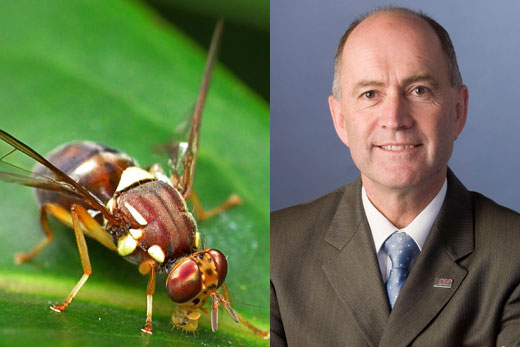
Kiwifruit Vine Health staff and other horticulture industries' representatives are in Whangarei this week for a site visit, where a single fruit fly was detected on January 21.
KVH CEO Barry O'Neil says the day-trip will allow officials to view the Ministry for Primary Industries' response to the detection, which so far hasn't found any more fruit flies.
KVH CEO Barry O'Neil will be visiting Whangarei this week to inspect the site where a single fruit fly was detected on January 21.
Barry, a biosecurity operational specialist, says while the recent discovery does heighten previous concerns he's raised over NZ's fruit fly risk, he believes MPI's Whangarei site response has been very good.
'It's been a quick response and a structured response – and the result has been very pleasing that no further flies have been found to date,” says Barry, who led MAF's emergency response efforts into incursions including 1997's Rabbit Calicivirus Disease, the 2005 Waiheke Island foot and mouth disease hoax and the initial MAF response to Psa-V.
KVH is participating in the one-day visit with other horticultural product groups, including those involved in kiwifruit, citrus, avocado and vegetable crops, plus Horticulture NZ.
'So we'll be meeting with the MPI response people, looking at the operation and trying to understand areas where, up to now, we haven't been absolutely understanding of why MPI are not taking additional action,” says Barry.
'So we want to make sure we understand clearly what the operational activities are.”
Barry says visitors will inspect how MPI is working to detect any more fruit fly 'and what they're doing to ensure fruit fly has not moved out of the area”.
'We've previously asked for further clarification with respect to the food outlets within the centre – a dairy selling fruit, a farmers' market and supermarkets for example – as we're wanting to understand the risks and controls put in place.”
'But we're also wanting to look at the whole programme as far as trapping, awareness and education efforts underway, the mobile laboratory, inspection of fruit collected from backyard gardens etc.”
Barry believes NZ's fruit fly risk was increasing before last month's discovery – 'but I don't know if there has been any significant change between December and now”.
'Our main concerns are the fruit fly situation in Australia has deteriorated – some of the state controls and previous free areas that they were maintaining no longer exist – and as such, we have a situation where Queensland fruit fly is basically endemic down the eastern side of Australia,” says Barry.
'And in our opinion, that does significantly increase the risk in light of the trade and travel that moves from Australia to New Zealand.”
In addition, fruit fly is in the Pacific Islands, says Barry, 'and changing climate conditions in NZ for establishment are more likely to support a population of fruit fly than maybe was previously the case”.
Barry says KVH has requested MPI urgently review risks of fruit flies entering NZ from Australia, in light of both the worsening fruit fly situation across the ditch and the Whangarei find.
Asked if the recent discovery has heightened his and KVH's concerns, Barry says it reinforces what they're saying, that the risks have increased.
'NZ's had three instances of Queensland fruit fly previously – most of the finds around the urban area of Auckland, so it is more concerning when we have a find in rural NZ – especially a major horticultural-producing area like Whangarei is.”
Asked if the introduction of Psa-V has strengthened the kiwifruit industry against biosecurity risks, Barry says the vine disease has made the industry very focused on such issues.
'Therefore, we're wanting to ensure we are absolutely fully-prepared – not just as an industry but the government and other horticulture sectors – so we've been working proactively with the government and sectors to look at a future programme needed under new policy called the Government Industry Agreement.
'And, we hope to have an operational GIA agreement for fruit fly – which is a partnership between government and industry – in place by July this year.
Barry says the policy was 'always going to happen” – but the MPI response in Whangarei has done two things.
'It's reinforced the risk we are facing as a large horticulture sector in NZ; and secondly, that we must learn from this more flies coming in and if we do we're best-prepared as we possibly can be.
'Any learning we pick up from this response needs to be picked up and put into the future programme – including where we can make improvements.”

0 comments
Leave a Comment
You must be logged in to make a comment.