


Bay of Plenty orchardists are holding their breath as they wait to find out if there will be more Queensland fruit flies found in Northland.
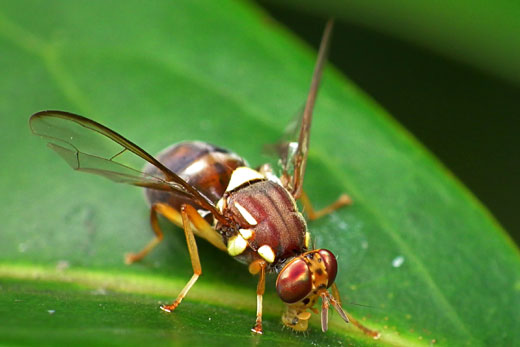
A single Queensland Fruit Fly was collected from a trap on Tuesday and formally identified on Wednesday.
The Queensland Fruit Fly. Photo: Wikipedia.
HortNZ president Julian Raine says it is an anxious time for all growers and the whole horticultural industry.
'We are watching the response efforts very closely and providing support and advice to the Ministry where we can.
'Growers appreciate the difficulties this is going to cause for people living within the controlled area that has been set up around the find.
'We thank them very much for their co-operation. It's not just commercial horticulture that needs their help, but all Kiwis with fruit trees and veggie patches.”
The risk to the $4billion New Zealand horticulture industry from the Queensland Fruit Fly is two-fold.
'First is the destruction caused by the pest and the on-going cost of attempting to control it, and second is the cost of international markets closing to our products, because those trading partners don't want to get the Queensland pest either.”
The export of fruit and vegetables is New Zealand's fourth largest export earner.
The Ministry for Primary Industries has announced that fresh fruit and some vegetables are not allowed out of Whangarei.
A Controlled Area Notice is in force for a 1.5km circular area around the location of where the fly was found in a surveillance trap, taking in parts of Parihaka, Riverside and central Whangarei.
Whole fresh fruit and vegetables (except for leafy vegetables and root veges) cannot be moved outside the controlled area.
'The Queensland fruit fly is an unwanted and notifiable insect that could have serious consequences for our horticultural industries,” says MPI Deputy Director General, Compliance and Response, Andrew Coleman.
'While we search for any further signs of the fruit fly in Whangarei, we need the support of local people.
'These legal controls are an important precaution while we investigate whether there are any further fruit flies present. Should there be any as yet undetected flies out there, this will help prevent their spread out of the area.”
MPI and its partners have deployed investigators in the affected area. They will be laying traps and checking fruit trees, vegetable gardens and rubbish bins for any signs of fruit flies.
'It is vital that we ascertain if the insect is a solitary find or if there is a wider population in Northland which will need to be treated,” says Andrew.
If further fruit flies are found, the Ministry says there will not be aerial spraying of insecticides as there are other more effective treatment methods available.
Kiwifruit Industry
Kiwifruit Vine Health president and Bay of Plenty grower Peter Ombler says if more fruit fly are discovered in Whangarei, the implications for the kiwifruit and wider horticultural industries could be serious.
'At the moment there is just one male fruit fly and while the discovery is of concern it's not cause for alarm at present. However, if surveillance in the next few days turns up more that will be a different situation.”
Peter says all of last season's kiwifruit has now been exported and the current crop is not yet ready for harvest so the fruit fly find will not immediately impact on that industry, but it may well affect others, especially if more insects are found.
The discovery of the insect is a reminder of the constant threats New Zealand's horticultural industry faces from such unwanted pests, he says.
'This illustrates the risks we face each and every day. The only way to stop any unwanted pests or diseases coming into New Zealand is to stop all trade goods and passengers coming here and that's not going to happen. That means we have to work out how to manage the risk.”
Kiwifruit Growers Inc president Neil Trebilco says all the industry can do right now is wait for MPI inspectors to carry out surveillance to determine if the find is a one off or not.
Now that Australia has changed its internal measures to control fruit fly, Neil says growers can expect to see more discoveries of insects in this country.
Australia has relaxed movement controls between states designed to reduce the risk of spreading fruit fly because moves to create fruit fly free areas have not succeeded.
On December 3, the Ministry for Primary Industries intercepted live cucumber fruit fly larvae (Bactrocera cucumis) on rock melons imported into New Zealand from Australia.
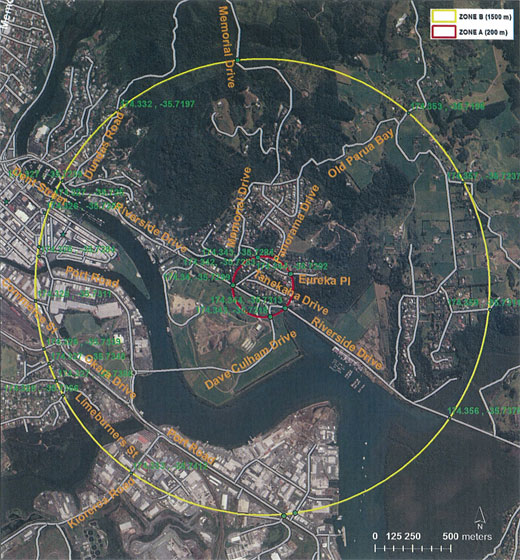 The Controlled Area.
Controlled Areas
Within the wider Controlled Area there is a smaller central Zone A taking in a circle 200 metres out from the initial find, and whole fruit and vegetables cannot be moved outside of this Zone at all.
Fruit and vegetables can continue to be transported from outside the Controlled Area into the Controlled Area.
Key fruits, vegetables and plants of concern are:
All citrus fruits, all stonefruit, pears, apples, blackberry, boysenberry, grapes, feijoa, passionfruit, tomato, eggplant, capsicum, pumpkin, avocado, custard apple, quince, persimmon, loquat, olives, oleander, kumquat, crab-apple, cape gooseberry and guava.
Residents are asked to avoid composting any of these risk fruits and vegetables. When disposing of fruit and vegetable waste, people are encouraged to use a sink waste disposal unit if possible.
MPI is providing special bins in the Controlled Area for the disposal of fruit and vegetable waste. The locations of these bins will be advised shortly.
'We appreciate this will be inconvenient for the many people living in and around Parihaka, Riverside and parts of central Whangarei, but compliance with these restrictions is a critical precaution to protect our horticultural industries and home gardens,” says Andrew.
'It is likely the restrictions will be in place for at least a couple of weeks.”
Full information will be regularly updated here.

0 comments
Leave a Comment
You must be logged in to make a comment.