


Its ten days into 2014 and 11 people already owe their lives to wearing a life jacket, reports Maritime New Zealand.
Those saved by lifejackets include two people rescued from a 5metre boat that capsized crossing the Raglan bar on January 2.
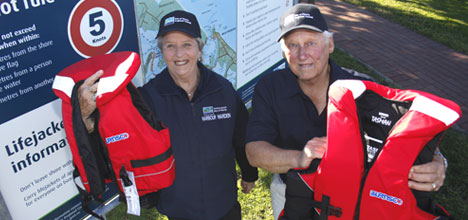
Frank and Pat Bullen display lifejackets that are already proving to save lives this year. Photo: File.
Then on January 5, three people were rescued after their boat capsized off Otago Peninsula.
Two teenagers wearing lifejackets were rescued after clinging to their upturned boat on Lake Taupo and calling for help using a cellphone on January 8, and on the same day four people wearing lifejackets abandoned their boat after it caught fire and began sinking near Pauanui on the Coromandel Peninsula.
A 49-year-old fisherman, who wasn't wearing a lifejacket when he fell from a boat in Wellington harbour on January 5, is presumed drowned.
In 2013, 19 people died as a result of recreational boating accidents, compared to 14 in 2012. A lack of lifejackets, or ill-fitting lifejackets, were a likely factor in 13 of the deaths, says Maritime NZ.
Lifejackets also saved lives in 2013. In January, four people wearing lifejackets were rescued after their boat sank off the mouth of the Taieri River in Otago. Four people also wearing lifejackets, were found clinging to their upturned boat and rescued after it sank east of Tauranga Bay in Northland on 27 October.
Two people, who spent 20 minutes in the water after their boat flipped on the Maketu bar in the Bay of Plenty in November, were also wearing lifejackets.
'Lifejackets save lives – it's that simple,” says Maritime New Zealand deputy director Lindsay Sturt.
'But lifejackets can't call for help and that's why we recommend boaties also carry at least two means of communications that will work when wet. This could include an emergency distress beacon, waterproof VHF radio or distress flares.
'People often rely on cell phones, but coverage can be limited and they should always be carried in a waterproof bag.”
Preparation can also go a long way towards preventing trouble occurring, says Lindsay.
'Skippers should ensure their boats are seaworthy and check the weather forecast and water conditions before they head out. Alcohol should also be avoided – it slows reaction times and reduces survival time if you end up in the water.”

0 comments
Leave a Comment
You must be logged in to make a comment.