


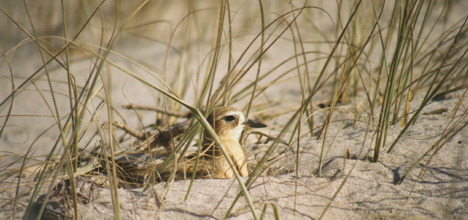
During the holidays, a large proportion of New Zealanders migrate to the beach – but they're not always aware of feathered residents, which reside along the coastline too.
Staff on the Bay of Plenty Shorebird programme are informing people to be aware of the birds using the region's shoreline, including threatened species such as the New Zealand dotterel.
New Zealand dotterels are well disguised in their natural habitat.
BOP Shorebird programme coordinator Julian Fitter says fencing will be erected in parts of the region to stop vehicles and people walking on nesting grounds and also to help protect the dunes.
'Previously, quad bike owners would drive all over [the dunes], which not only endangers nesting shorebirds, but also kills small plants that are just starting to develop and hold the sand,” says Julian.
'Vehicle drivers cannot see the well-camouflaged eggs on the sand and may run over the nests, or simply drive the birds away from their nests.”
People, pets, and horses can also pose a major threat by trampling on nests and disturbing birds during breeding.
Julian says visitors can play their part by not disturbing bird and nests when at the beach.
'Keep below the high tide mark; keep dogs on a short leash, and preferably leave them at home. If you see a bird simulating injury, or acting as if it objects to your presence, then please move on quicklyas the bird probably has a nest nearby.”
Only about 150 of the 2400 New Zealand dotterels live in the Bay of Plenty, between Waihi Beach and Opotiki.
Julian says the Rena oil spill resulted in a 10 per cent drop in numbers – partly from the oil and partly from ‘protective captivity', of people taking birds from nesting grounds.
Since then, it has been reported NZ dotterel numbers are starting to increase again.
'As a visitor to our beautiful beaches, you can do your part to protect these delightful and iconic species,” says Julian.

1 comment
Overit
Posted on 21-12-2013 17:17 | By overit
The dotterels will get a hammering if the Matakana Development goes ahead. They live along the harbour entrance.
Leave a Comment
You must be logged in to make a comment.