


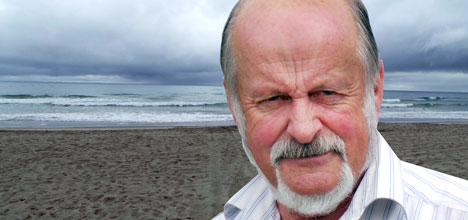
A mysterious tidal surge that knocked over fishermen on Papamoa Beach last month is being explained as a meteo-tsunami caused by the weather, says NIWA scientist Rob Bell.
The wave at low tide at 5.30am on November 23 knocked over fishermen and washed a Kontiki ashore.
Grahame Lindsey was knocked over when a meteo-tsunami hit Papamoa Beach.
Grahame Lindsey was fishing the bottom of the tide at Karewa Parade when he was stunned by the wave that powered up the beach.
'It came up to nearly the high water mark,” says Grahame. 'It was low tide, it was about half past five and it brought the Kontiki in and laid the lines up the beach. It came in - it wasn't just a wave - it was like a tsunami.
'It was quite frightening really. First time I have been fishing on the beach when that's happened.”
Inquiries at the time failed find any regional, or even remote earthquakes or volcanic events, that may have caused the surge.
The only possibility left is that the surging beach waves are caused by the weather, says the National Institute of Weather and Atmospheric Research scientist.
They are called 'tsunami-like” long waves, sometimes called rissaga or far-infragravity waves.
Unlike tsunami generated by a geological event, the cause event is virtually undetectable as is their progression across deep ocean spaces, says Rob.
'There a quite a few documented cases now in New Zealand where these meteo-tsunami or long-wave surges have been observed,” says Rob.
'They are usually more noticeable at low tide with surges covering the beach. Their causes and why they only occur sometimes for similar weather or wave conditions are still a matter of ongoing research worldwide – so they are difficult to forecast ahead of time.”
There's enough evidence from the November 23 event to show the surges at Papamoa at 5.30am, and possibly other Bay of Plenty beaches that were not observed, are almost certainly a meteo-tsunami caused by swell waves to the north-east of NZ.
The one-minute sea-level data from Moturiki (Leisure) Island gauge show oscillations superimposed on the tide curve that are a classic signal of long wave activity with periods of around five minutes.
The circled area shows a 5 minute long wave was measured around 4:30am with a wave height of around 0.2m, which would have been higher as it shoaled onto the beach and may have been more focussed onto the Papamoa Beach, says Rob.
Weather and wave forecasts from NIWA's EcoConnect operational forecast at the time show a shallow depression well off to the north east of the Bay of Plenty, producing a wide wind band from the south-east up and around the top of New Zealand.
'This generated a wide band of moderate swell waves to the north of NZ propagating from the east,” says Rob.
'Sometimes, sets of swell waves or wave packets, can produce a longer period wave that breaks free from the swell wave train and propagates as a 'tsunami-like” free wave with wave periods of 3-10 minutes.
'This appears to be what has happened in this case, although it's not clear why this particular set of weather and wave conditions sometimes produces these surges and not at other times.
'A moving low-pressure system sliding down the dateline to the east of NZ can also produce a similar ‘bow-wave' type long wave that can also cause the same beach surges, or can combine with the swell-generated long waves.”
Another documented event was at Waihi Beach on March 15, 2008, which occurred while a similar shallow depression was off to the east of the Bay of Plenty.
Read more about the wave incident here.

0 comments
Leave a Comment
You must be logged in to make a comment.