


A large tract of land near Ohope Beach is being returned to pasture after 28 years in pines.
Richard and Pia Evans, and Richard's brother Chris Evans and his wife Melanie, have undertaken the challenging project of converting about half of a 1000 ha farm from forestry to farming with considerable success.
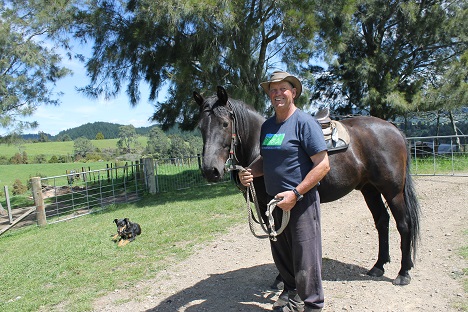
Peter Simpson prefers to move cows and calves from horse back to reduce stress on the animals.
Farm manager Peter Simpson says the decision to farm much of the Stanley Rd land goes against the current trend for many farms in the area, which in recent decades have been progressively planted in trees.
'This land was originally cleared for pasture before it went into trees, so what Chris and Richard are doing is converting it back to farmland. When you look at the land, it is in close proximity to the coast, its climate and wonderful views; it is understandable they should want to do this.”
Earlier this year the property was the subject of a Beef + Lamb field day when other drystock farmers had the opportunity to see what could be done on a former forestry block, with most being impressed with the results.
Today, 500 ha has been converted from pine and eucalyptus plantations to farm land. With the last of the trees being harvested in 2006, about 65 kilometres of fencing (most of it conventional but some electric), has been constructed, creating 56 paddocks, with more subdivision still to come.
Pines still grow on 200 ha; and 300 ha are planted, or are in the process of being planted, in pines, redwoods and other species with a focus on planting riparian areas. The owners are working closely with the Bay of Plenty Regional Council to plan plantings for the most sensitive areas of the land.
The 500 ha of grazing winters 145 Angus cows, 72 in-calf rising two year olds, 66 rising two year old steers, and 144 mixed sex weaners. It also runs 1150 mixed aged ewes, 735 two-tooth and 200 hoggets.
This year Peter is raising a small herd of 20 Angus-Jersey cross heifers in the hope they will do well on the farm. 'I'm hoping that because of their smaller size we can run more to the hectare, and yet still produce calves which will grow well.”
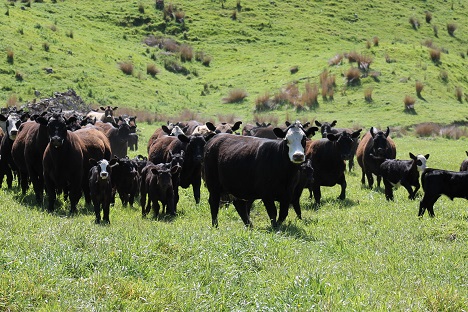
Angus cows and calves graze in the valley of an Ohope farm, once covered in forestry.
One advantage of converting a harvested forestry block back to pasture is the network of tracks left over from the logging operation, making it easier to access all parts of the farm which ranges in contour from a deep flat valley to rolling land to steep sidlings.
However, Peter prefers to use a horse rather than motorbike for stock work, especially that involving cattle – and not just because he's a very keen horseman. 'It's so much less stressful for cows and calves to work them from horseback.”
Peter says the wood harvesting left behind generally breaks down reasonably quickly; and by applying fertiliser and planting the right grass species, the land will once more grow good pasture.
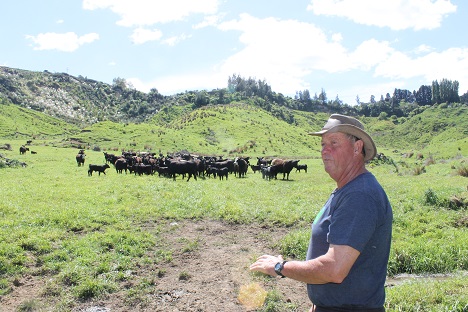 Peter Simpson on the farm at Ohope.
However, it also grows good weeds and weed control is an issue, particularly in the early stages of conversion.
Peter says there's no short cuts or quick fixes to transforming forestry to farmland and the Evans brothers understand that too. 'They are focused on doing everything well, including building excellent stock handling facilities and keeping accurate records of stock performance.”
Richard and Pia and Chris and Melanie have both built homes on the farm and have children who attend local schools. Both families are very involved in the district and schools and make the most of the coastal and beach environment on their doorstep.

0 comments
Leave a Comment
You must be logged in to make a comment.