



The work of volunteers who cleaned up Bay of Plenty beaches in the wake of the Rena oil spill is being vindicated in scientific surveys and changing the way oil spills are dealt with internationally.
The community response to the heavy fuel oil that washed up along the ocean beach in early October 2011 forced Maritime NZ to change its approach to dealing with the disaster, according to an independent report released today.
Professor of Coastal Marine Science at the University of Waikato, Dr Chris Battershill talks to media at the release of the report into the Rena today.
The container ship Rena struck Astrolabe Reef early on October 5, 2011. The ship's bow section was hard aground while its stern section remained afloat.
More than 350 tonnes of heavy fuel oil leaked from the grounded ship and the cargo holds flooded. It eventually broke up sending containers into the ocean that washed up along beaches across the Bay of Plenty.
Read SunLive's full coverage of the Rena grounding here.
Fuel oil from a ruptured tank began washing ashore across Tauranga's beaches during a storm that struck the wreck on October 10.
But according to the report into Maritime New Zealand's oil spill response, by independent reviewer Simon Murdoch, volunteers were not part of the government agencies oil spill response plan.
It was only after local council officials gained access to MNZ officials and the incident control centre, set up at the old Foodtown building on Cameron Road, was a plan for organising a volunteer effort put in place.
'This was an important adjustment to the MNZ response doctrine and the national plan,” says the report released today.
'It was strongly encouraged by the minister of the time Steven Joyce, and others whose understanding of the Christchurch experience, The Student Army and Farmy Army, gave them confidence that the risks that arose would be outweighed by the benefits.
'To deny the concerned public the possibility of useful engagement seemed highly counterproductive.”
By the end of public clean-up the volunteers were an effective multiplier to the official response and were recognised as essential to the response.
International maritime organisations have shown considerable interest in the volunteer regime and how it worked, says the report.
There were 8000 registered volunteers, 40 corporate or group offers of labour, 57 voluntary caterers, 150 clean-up events, 240,000 man hours of effort and $350,000 worth of protective equipment purchased.
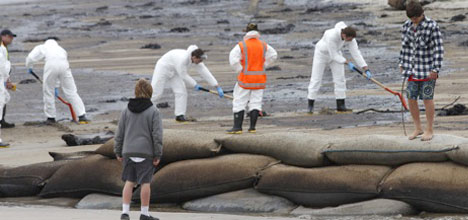 Volunteers clean oil from the beaches.
Maori were similarly outside the original response envelope and within days of the grounding were working Wellington contacts to obtain access to the ICC and demand recognition of mana, and to become connected with the official response.
MNZ originally didn't know what to do with local Maori, and tried to channel them through the Department of Conservation and Te Puni Kokiri – but persevered because MNZ recognised the same risks of counter productivity applied in respect of discouraging the local community, says Simon in the report.
Iwi used local connections and networks from 136 marae across the BOP to mobilise large numbers of people and volunteers, and when incorporated into the response operation markedly increased the productivity of beach clean-up.
The scientists studying the longer term impact of the Rena oil spill on the marine and inter-tidal environment find the volunteers are more effective than other methods of cleaning up oil spills.
Professor of Coastal Marine Science at the University of Waikato, Dr Chris Battershill, says there is still oil in the sand of Queensland's Sunshine Coast where 270 tonnes washed ashore from the Pacific Adventurer in March 2009. The beach was cleaned up using machinery and there is still oil in the sand.
He can't find any Rena oil residue on, or in, the beaches where volunteers spent hours on their hands and knees sieving oil from sand across the beaches, and scouring rock pools for infested waters.
The report finds that Maritime New Zealand's initial response to the grounding and oil spill from the cargo ship Rena was flawed but generally effective.
The report says while core technical staff were well-trained and prepared for a limited range of incidents, senior managers were relatively unseasoned for the most serious Tier 3 response.
Few Wellington based elements of a Tier 3 response and the administrative staff, who would reinforce the ICC, had been exercised. It was also the first time there was ever a 'cold start” Tier 3 incident.
Dependencies on other central government capabilities for a Tier 3 response had been identified, but not formally included in Memoranda of Understanding.
MNZ's cadre of senior managers for a Tier 3 response was relatively unseasoned. The new Executive Team, which had had some exercising and training exposure, had only two members of suitable experience, says the report.
The pool of National On-Scene Commanders was at a historically low ebb, and the response under the management was untested.
But in MNZ's favour the report says the common view of the Rena incident as a maritime casualty is that it was one of the most complex response challenges in the world in recent years where container vessel incidents are concerned.
Report writer Simon Murdoch was told this by international and domestic experts in many different ways, but most graphically when it was said that if the response system had had a measure of severity above the equivalent of Tier 3, to a Tier 4, the Rena grounding would have qualified at that higher level.
Thus, the Rena response was bound to test the limits of planned capability in MNZ generally, but particularly in the Marine Pollution Response Service.
As well as lacking core staff trained or prepared for the complexity of incident management, MNZ was also hampered by the ‘proscriptive' NZ legislation requiring it to stick to a plan of response for an oil spill, but not to other elements of pollution risk.
The NZ Marine Oil Spill Strategy and the National Marine Oil Spill Contingency Plan do not address wider pollution risks.
The national strategy does not put forward in a coherent way the distilled knowledge of MNZ about the core strategic principles it should follow when conducting a multi-layered response to a complex casualty.
Its recently restructured Executive Team was lacking in institutional memory of this kind and could not retrieve it in such a way as to influence the Rena response in its initial stages.
Transport Minister Gerry Brownlee also annouced today $2million is going to MNZ to help the government agency improve its response capability.
'The review makes it clear that the Rena grounding was one of the most complex maritime response challenges in the world and would have tested the limits of any plan.
'While the response was not as efficient as it should have been in the initial stages, it improved quickly and became very effective, which is borne out in the largely positive environmental results of the Rena Recovery Plan's scientific monitoring programme, also released today,” says Gerry.
The Rena response was about more than oil, and the key recommendation from the review involves developing a wider response capability and associated contingency planning to address both oil and non-oil issues such as salvage, debris and other pollution.
'To do this the Government is providing more than $2.05 million over three years to fund a package of work by MNZ to address the risks posed by future complex maritime incidents.”
Read the full report here.

0 comments
Leave a Comment
You must be logged in to make a comment.