


New Zealand farmers stand to benefit from new research funded by Ballance Agri-Nutrients that will look at the most efficient use of nitrogen fertiliser for pasture growth.
The three-year study, which will build an understanding of how pasture absorbs and metabolises nitrogen, is being conducted by a Postdoctoral Fellow Jonathan Love and two PhD students at the University of Canterbury.
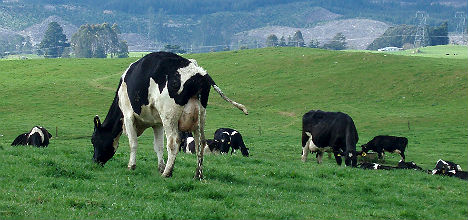
Cows grazing on pasture and excreting urine are part of the nitrogen cycle.
Ballance research and development manager Warwick Catto says while New Zealand is uniquely placed to provide high quality food for a growing world population, investment in agricultural science and innovation is critical to keep our edge.
'New Zealand farmers lead the world in efficient pastoral-based farming and our economy is intrinsically linked to it. To keep that lead we must invest in on-farm efficiency and sustainability and, in this case, the most effective use of nitrogen.”
Improved nitrogen efficiencies can potentially lead to an important secondary benefit of reduced nitrate leaching. This is due to the flow-through impacts on the grazing animal, with improved nitrogen utilisation and therefore less urinary loss.
Jonathan says while nitrogen is essential to produce enough food for the world's growing population, its efficient use is essential to keep farm expenses down and to minimise the environmental impacts of overuse.
'Our agriculture industry wouldn't be where it is today without nitrogen as a fertiliser – it's an essential macronutrient for plant growth. Between 30 and 50 per cent of crop yield can be attributed to fertiliser use and, with the world population expected to double by 2100, it's vital we understand how to get the best results for us and the environment.
'To sustain the world's population, our agricultural productivity needs to grow by two per cent per year; at the moment we're growing at just over one per cent.”
The research will take a broad approach and will seek to answer three key questions: how is nitrogen uptake regulated in pasture grasses; how can the uptake of nitrogen be improved; and whether combining plant hormones with nitrogen fertiliser will lead to improved efficiency.
'To answer these questions we're looking at external factors like temperature, moisture and nutrient availability as well as the grass's internal mechanisms that send signals within the plant in response to inputs such as nitrogen,” Jonathan says.
'Because the plant uptake and response is limited, much of the added nitrogen is never used and then becomes exposed to processes in the soil, which result in it being lost to either the atmosphere or groundwater. We hope to improve the upstream processes of uptake and growth response to avoid the downstream losses.
'Ultimately, what we're trying to do is help farmers improve the uptake of nitrogen in grass; and, therefore, use less of it per hectare to produce the same or more grass growth.”

1 comment
Beyond 2021
Posted on 01-12-2013 22:56 | By Dollie
The thought is abhorrent but maybe we will be looking at cows on concrete or such like and bringing feed in.
Leave a Comment
You must be logged in to make a comment.