


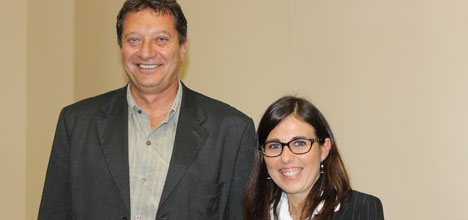
Some Italian kiwifruit orchards have returned to productivity as growers learn to manage the vine disease Psa-V, says Dr Marco Scortichini of the Centre for Research on Fruit Culture of Rome.
Growers have changed their approach to Psa-V and are able to manage it more like other diseases, he told a meeting of around 80 kiwifruit growers in Te Puke ahead of today's two hour Psa Symposium Overview Session for wider Kiwifruit industry at ASB Arena.
Dr Marco Scortichini and Dr Milena Petriccione of the Centre for Research on Fruit Culture of Rome.
Marco says he has confidence in the future of the kiwifruit industry, both in Italy and New Zealand thanks to what has been learned about Psa, changes in management techniques and the breeding of new more tolerant vines.
In Italy agronomic techniques are being modified, including balanced crop nutrition, reduced use of nitrogen, less hormones, shaping canopies to allow more air flow, and changes in irrigation methods, he says.
'New cultivars having some tolerance genes will be released and cultivated. New pollinator clones will also be released.”
Marco is world renowned for demonstrating bacteria can be present in plants without causing any symptoms, and that stress conditions will trigger secondary or disease symptoms.
He says the disease triangle includes a very susceptible host (such as Hort16A gold kiwifruit), a very aggressive strain of bacteria (such as Psa-V) and autumn, winter frosts and high rainfall. All those factors came together in Italy in 2008 with devastating effects for many growers.
Despite speculation the disease may have arrived in New Zealand on pollen, Marco says the role of pollen in the transmission of the disease has yet to be demonstrated but he recommends growers use only certified Psa-free pollen.
He also recommends planting the new yellow cultivar known as G3 which is believed to be more tolerant to the disease.
Understanding the disease cycle and using protectant sprays when the risks are high is also recommended.
Dr Milena Petriccione also addressed the meeting at The Orchard church organised by the New Zealand Bio-Tech Association. She outlined her research into how kiwifruit vines respond to a Psa-V infection and the proteins produced as it attempted to ward off the disease. Now she is researching methods for the early detection of the disease.
Marco and Milena were the first to publish the genomic sequencing of Psa V, and to establish that Psa V had the genetic potential to resist copper spraying and to detoxify antibiotics.
As well as the grower meeting in Te Puke, the pair also addressed other scientists at the first International Symposium on Bacterial Canker of Kiwifruit (Psa) organised by Plant & Food held in Tauranga this week.
Today's symposium will include updates from Prof Guglielmo Costa of Italy and Dr Ross Ferguson of New Zealand who will outline the global Psa situation. Dr Huang Hongwen – will speak about the diversity of Psa causing bacterial canker of kiwifruit in China. Dr Francesco Spinelli will present a summary of Italian research work and questions following the presentations will be moderated by Dr Dave Tanner of Zespri.

0 comments
Leave a Comment
You must be logged in to make a comment.