


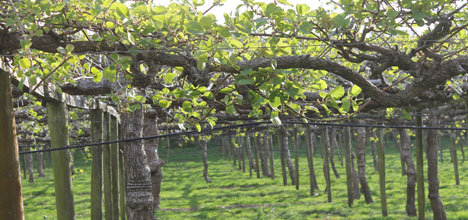
The aggressive bacterial vine disease Psa-V has been identified for the first time on Hort16A gold kiwifruit vines in Kumeu, north-west of Auckland.
Kiwifruit Vine Health Chief Executive, Barry O'Neil, says this new find was picked up in the recent ‘mandatory monitoring' round.
'Once again it's very disappointing that Psa-V has been found in another region.
'However, due to growers carrying out their mandatory monitoring in the region, the disease has been picked up early; and early detection is essential to a rapid response.
'Our message to growers in every region remains the same - all New Zealand growers must be proactive and take adequate measures to protect their orchards. Ongoing monitoring, protective spray programmes and strict hygiene measures must be maintained.
'Don't wait for Psa-V to be found in your region before you start monitoring,” he says.
The latest find means only the Whangarei district and the South Island are currently believed free of the disease. The disease has seen a total removal of Hort16A vines in the worse affected areas of Te Puke with replacement of new varieties thought to be more tolerant of Psa.
In an effort to manage the disease and limit its further spread, KVH has established a ‘North-West Auckland Controlled Area' with a 10 kilometre radius around the infected orchard. The new controlled area includes 22 KPINs (Kiwifruit Property Identification Number).
There are 25 KPINs in total in the north-west of Auckland, comprising almost 86 hectares of mainly Hayward green kiwifruit.
KVH representatives have met with north-west Auckland growers to give them an update on the situation and best-practice advice going forward.
Growers in the North-West Auckland Controlled Area are advised of the following.
- Monitor vines intensively for suspicious Psa-V symptoms and repeat monitoring fortnightly. Report monitoring information to KVH through the website tool www.kvh.org.nz/monitoring_plan.
- Maintain strict orchard hygiene procedures as per KVH Best Practice: Orchard Hygiene. Refer to www.kvh.org.nz/hygiene.
- Apply an effective crop protection product as soon as possible. Refer to the spring spray programme in the KVH Seasonal Management Guide—Spring/Summer available on the KVH website www.kvh.org.nz/spring_summer.
- No kiwifruit plant material, including budwood and nursery stock, along with any potentially contaminated orchard equipment, can be moved out of this area.
- KVH authorisation is required when beehives within the controlled area need to be moved.

0 comments
Leave a Comment
You must be logged in to make a comment.