


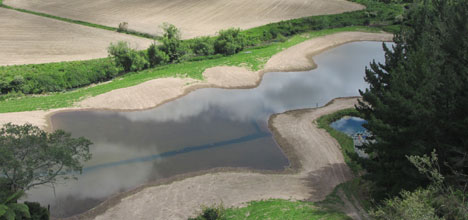
The Bay of Plenty Regional Council, which helped in turning a Te Puke hay paddock back into wetland, now wants to assist others to do the same under its commitments to the Kaituna River Re-diversion project.
The Kaituna wetland.
The new wetland re-creates a former habitat that existed along the Waiari Stream's floodplain last century, with the council getting involved as part of its commitment to implementing the Kaituna River Re-Diversion and Wetland Creation project.
BOPRC land management officer Ryan Standen says the Te Puke paddock used to be kept dry by draining springs directly into the Waiari Stream.
'Constructing the wetland was relatively easy, blocking drains to re-flood the area, building a structure to control the water level and an emergency spillway in case of flooding.
'There's a native fish passage from the Waiari Stream into the wetland through a culvert, which has old mussel farm rope in it for native fish to climb up,” says Ryan.
'The edge of the wetland will be planted over the next few winters, and pest animals like stoats and rats which prey on wetland birds will be trapped.”
Now, the council's Natural Resource Operations Group is offering help for landowners who want to create new wetlands within the Kaituna River catchment.
'Assisting landowners to create wetlands in the Kaituna River catchment is part of the regional council's role in implementing the Kaituna River and Ongatoro/Maketu Estuary Strategy. We want to create 100 hectares of new wetlands in the area.
'We'd like to see more wetlands to improve water quality, provide habitat for native species, cultural use and recreational opportunities.”
Wetlands were among the world's most productive environments, home to a wide variety of plants and animals which had specially adapted to living in wet places, according to Ryan.
An international report earlier this year urged a major shift in attitudes to wetlands, 'to recognise their value in delivering water, raw materials and food essential for life and crucial for maintaining people's livelihoods and the sustainability of the world's economies”.
Wetlands also absorb water during heavy rain, releasing water gradually to reduce flooding. Downstream water flows and ground water levels can also be maintained in dry weather; and plants act as a filter to remove nutrients and improve water quality.
'Wetlands support the greatest concentrations of bird life of any habitat in New Zealand and far more species than a forest. Migratory species of birds and fish also depend on chains of suitable wetlands,” says Ryan.
'Over the last century we've lost significant wetlands around Te Puke, particularly in the Kaituna River catchment; and we only have less than two per cent of the freshwater wetland that existed in 1840 now. The community is concerned about the loss of wetlands and the vital function they have in a healthy eco-system.”
Landowner Murray Fenwick says creating the wetland on his property was an exciting development. 'It's great to be able to return some of this land to the wetland it used to be, and then watch the bird life and plants return as well.”
With plans to re-divert nearly one-quarter of the Kaituna River's flow back into Ongatoro/Maketu estuary to improve its health and create several wetlands, the council is holding an information evening next week for those interested in the re-diversion project.
BOPRC project manager Pim de Monchy says the evening – from 6pm Thursday, November 21, at Maketu's Whakaue Marae – is an opportunity for everyone to see a preferred option, find out what the council has learned from modelling exercises, and ask questions.
'The council has been talking to the community about the options for several months, and the information evening is a chance to find out more about what the preferred option looks like and what happens next,” says Pim.
'It's the first public meeting since the option was selected, and more information days will be held in February and May next year to ensure everyone has a chance to see what's planned and raise any questions with us.”
Pim says the Maketu community has long been concerned about degradation of their estuary since the Te Tumu cut was opened in 1956. 'The opening made the estuary more saline, contributed to the loss of nearly all wetlands; and reduced the estuary's ability to flush out sand and mud.”
The council plans to apply for resource consent in mid-2014, designate land required for the project; and construction is planned to start by the end of 2015, once requirements are met.
The council can help create new wetlands with funding from biodiversity or sustainable land management programmes. A Wetland Restoration Guide is on the council website: www.boprc.govt.nz or call land management officer Ryan Standen 0800 554 881 extn: 8503.

1 comment
WET WETTER
Posted on 17-11-2013 13:20 | By peecee09
Now lets allow all the farmland between Pukehina Beach and SH 2 revert to the magnificent wetland it once was instead of allowing the dairy farms on this land continue to pollute the waterways and the Little Waihi estuary. I understand that one dairy cow releases 20 litres of nitrogen rich urine every day. There are approx 5 or 6000 cows on this land , times 20 litres equals a disgusting 120,000 litres a day leaching into an environment that just can't handle this level of enrichment and is dying.
Leave a Comment
You must be logged in to make a comment.