


Roading is among the biggest expenses when it comes to harvesting a farm forest for the first time, says Wood Marketing Services Limited's sales manager Darren Robinson.
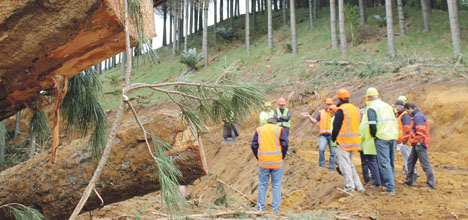
Members of the Bay of Plenty Farm Forestry Association visited a harvest operation near Te Puke.
'Few investors have the funds to establish roads when they plant a forest, because they are likely to remain pretty much unused until the harvest in 20-plus years' time,” says Darren, while speaking to Bay of Plenty Farm Forestry Association members, who visited a harvest operation near Te Puke in late October.
On the 116 hectare hill-country site the association members visited, between $150,000 and $180,000 has been spent so far on building roads to harvest trees aged 21 to 22 years old. The roads have to be of sufficient standard to cope with the large production and therefore the volume of heavy trucks transporting logs to the Port of Tauranga.
However, despite the significant initial cost, the roading network will be an asset for the second round of harvest, now the land is being re-planted.
Currently, prices are good – and Darren says it is important to harvest when the market is favourable, rather than wait for trees to reach a specific age. 'Generally, if the market dictates it's an ideal time to harvest and the trees are of a size and age which is acceptable and economically viable, they are ready to harvest.”
Location and access can be financially beneficial when choosing a forestry site. 'This location is ideal because it's so close to the Port of Tauranga, which is where 90 per cent of the timber harvested here will go, saving significantly on transport costs.”
All of the export timber is bound for China, where it will be used mostly to make pallets and packaging, as well as plywood boxing for concrete formwork.”
Despite its end use, Darren says it is important forest owners manage their woodlots well, including pruning trees – citing it can make the product worth up to $30 extra per tonne.
A small percentage of the timber from the block will go to domestic markets for local market use.
The Bay of Plenty Farm Forestry Association holds regular field trips to visit forests featuring a range of species and ages, as well as nurseries. The next event is Friday, December 6, when members will visit the New Zealand dry land eucalyptus trail site in the TECT All Terrain Park at Pyes Pa. To find out more about the day, email Ben Banks at: [email protected]
For more information on farm forestry, go to the Farm Forestry Association national website: www.nzffa.org.nz

0 comments
Leave a Comment
You must be logged in to make a comment.