


The kiwifruit industry has another two to three years before it can claim recovery from the vine disease Psa-V but it's nonetheless on the cusp of turning a corner into positive territory, believes Zespri's CEO.
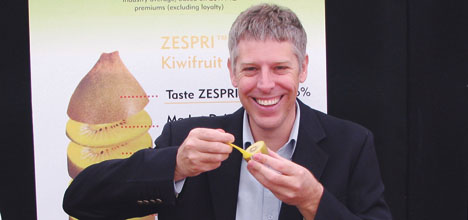
Lain Jager Zespri CEO says it is vital the new gold fruit achieves the best possible taste standards.
'We still have some tough years ahead to recover financially and in terms of crop volumes,” says Lain Jager.
'Psa could still be severe in future seasons but in two to three years I think we will look back at the industry response to the disease and see it as a case study for how to recover from a serious bacterial infection.”
Optimistic though he is, Lain says the last three years have been brutal – and for many individual growers the suffering is far from over.
They have lost income from vines, which were cut out and re-grafted and many saw equity in their orchards diminish, says Lain.
'However, as an industry the recovery signs are there. The new gold G3 is looking ‘pretty good' and there has been a recovery of capital values of orchards. We haven't seen any fire sales lately, which means the life savings of most growers have not been lost.”
This year two million trays of G3 were exported. Next year that's expected to increase to 10 million; and in the next five years, to 50 million trays.
Growth
'By then the industry will have gone from recovery mode to a growth mode – and from a personal point of view, I'd much rather be part of an industry which is growing, than one forced to retrench.”
While growers struggle to recover from their financial losses and re-build production, the post-harvest sector has also been hard hit, says Lain, citing fierce competition for a reduced crop volume and challenges of keeping key staff and infrastructure in place, ready for the growth to come.
'Psa could have caused the industry to blow apart, but instead it pulled together and acted collectively to confront the issue.”
In many ways the crisis Psa sparked was worse than that of 1992, when worldwide over-production of kiwifruit caused prices to plummet.
However, the industry can look back and be grateful for the structures put in place as a result of that financial crisis because they have served it well in the current one, Lain says.
'The industry was able to react collectively and the Industry Advisory Council, New Zealand Kiwifruit Growers Inc, Zespri, and the New Zealand Government, was able to put together the $50 million funding package in just one month which was an astounding effort.”
Zespri is a marketing company and its role during the Psa crisis was to facilitate the initial response, which was then picked up by the wider industry, including the post-harvest sector and led also to the formation of the new body; Kiwifruit Vine Health.
Shock
Lain says his initial reaction to news Psa was in New Zealand was one of shock.
'We didn't know what it meant for growing kiwifruit in New Zealand. We had little understanding of its impact on green and gold.
'It really rammed home the risk the industry faced through too much reliance on a single cultivar, Hort16A, and the debt levels for many.
'It forced the industry to pull the levers and cut out Hort16A and replace it with G3. Growers have grafted 4000 ha to G3, which was a bet on the future because the best we could say is that it appears more tolerant of Psa than Hort16A and so far that appears to be true.”
What has also been learned is what are the best spray programmes and products, including low levels of copper, to manage Psa; and that while Hayward females appear to come through infection, the male vines can be hard hit.
'Today, for many growers, managing Psa is business as usual. But what it has exposed is that those who are good horticulturalists will, almost by definition, be in a strong position, while those who are not so technically focused may struggle,” says Lain.
Resilience
Lain says he is continually impressed at the resilience and determination of New Zealand's 3000 kiwifruit growers, 60 per cent of who now grow a Zespri-patented plant variety kiwifruit. 'The industry now grows a multi-variety crop, which gives a more balanced portfolio, which will eventually be evenly divided between green and gold.”
As so often happens in a crisis, the response to Psa revealed strengths within individuals, many of whom Lain describes as heroes. They include Peter Ombler, then president of New Zealand Kiwifruit Growers Inc; Ian Greaves of Kiwifruit Vine Health, who with grower Braden Hungerford took the lead in caring for grower well-being; Zespri's David Tanner and Shane Max; and the individual growers, who took on co-ordinator roles in growing districts throughout the country, assisting orchardists with their response to Psa.
Post-harvest operators also took grower welfare seriously, including removing plant material from orchards when growers were so overwhelmed they couldn't cope.
The kiwifruit industry has always been strongly networked, but Lain says Psa has brought that aspect to the fore, in terms of grower welfare, research and development, and the sharing of technical and management information.
'It's been horrible but I do take some satisfaction from being part of the collective effort, which has seen the industry chart its way through rough water to what promises to be a bright future.”
No-one is taking focus away from Psa, but now the sense of crisis has passed, there's more attention to the future, including how to maximise returns from the new gold G3, says Lain. 'We have to ensure G3 achieves the best possible taste standards, which means high levels of dry matter, and there has been no push back from growers to those standards, which is very pleasing.”
Zespri is positioning itself to manage the predicted growth in export volumes 'and to ensure G3 is the best gold kiwifruit in the market”.

0 comments
Leave a Comment
You must be logged in to make a comment.