


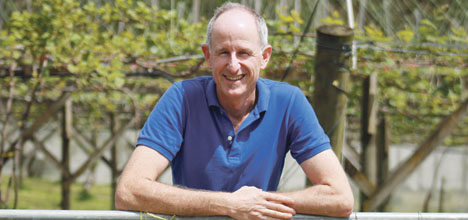
Ian Greaves, who says he doesn't handle stress well, nonetheless took a leading role in helping kiwifruit growers cope with the extremely stressful emotional impacts of the vine disease Psa-V.
Three years on from the incursion of the disease, what Ian and others in the Kiwifruit Vine Health and New Zealand Kiwifruit Growers Inc team managed to do to help growers is now considered a template for other industries facing similar crises. However, Ian says the response to a threat, such as Psa-V or others, which impact on livelihoods can't be written up as an academic paper or like an accounting model to apply across the board.
'It's about people, not paper work – about having the right people, who are well recognised and respected, who have empathy for others, almost always due to their own life experiences, to take a lead.”
Sir John Kirwan, a famous former All Black, who fronts a nationwide campaign aimed to help people suffering from depression is a classic example of the kind of leader required, says Ian.
'And the kiwifruit industry has a whole bunch of people, who understand exactly what it's like, or have been there themselves – who are able to empathise with others.” Ian, who has interests in dairying and kiwifruit, was among those to step up early in the piece. Before he did, Ian made sure his own family and financial future were as secure as possible. 'We were fortunate that we could do that. Many growers didn't have those options, but once I knew we were reasonably okay, then I could concentrate on helping others.”
Wellbeing
It was John Burke, then general manager of Kiwifruit Vine Health, who asked Ian to take care of grower welfare in early 2011. 'John said KVH was concentrating on the vines, and the NZKGI [focussed on] the financial situation of growers; but someone needed to keep an eye on grower wellbeing.”
One of the first things Ian did was to seek out all the information he could on individuals and organisations which could help, putting together a small pamphlet with lists of names and contact numbers, which was given out personally to growers attending Psa meetings.
'I spoke to the Rural Support Trust, but it can't swing into action until an adverse event was declared – that didn't happen for two years and we couldn't wait that long.”
However, Derek Spratt, Sandy Scarrow, John Allen, and others from the trust offered support, attended and spoke at meetings and shared data on helping agencies. A meeting was called in Te Puke of local church leaders, police, ambulance staff and doctors, enlisting their support.
Angry
The next phase of the programme was triggered by a series of angry phone calls. 'All at once at KVH we got several really angry calls from growers and realised this was part of the grief cycle. Anger usually follows the feeling of shock and denial, then pain and guilt.”
Ian enlisted clinical psychologist Leanne Dunne, of Tauranga Psychological Services, who along with Terry Wynyard from Civil Defence, talked to a meeting of representatives of kiwifruit and community organisations to help them understand the nature of the crisis, how it would unfold for those most affected, how to help when someone appeared desperate, and how those involved in helping should also look after themselves.
A series of pastoral seminars were organised by KVH and NZKGI, led by Leanne and Aubrey Quinn of the Turning Point Trust of Tauranga. From this time on, NZKGI took over the grower wellbeing role from KVH; and through industry donations and grower funds, financed the support operations. In December 2012, the Government declared an adverse event and many of the operations have been funded since from Government Adverse Event funds.
Most seminars were initially in Te Puke; and while some attracted as few as four, others (like one organised by Rural Women NZ), saw 125 people attend. 'That really broke the ice,” says Ian.
'This biggest thing the meetings did was let people know they were not alone, what they were feeling was not unusual, it was okay to talk about how they felt, and there was help available. It also enabled family, friends and neighbours to recognise the signs that someone needed help.
Risk
'There was concern that talking about suicide might increase the risk of people harming themselves, but the research does not support that. Talking about how to do it is obviously not a good idea, but asking someone if they were so depressed they thought of killing themselves can actually decrease the risk.”
Ian says while younger people in the industry – those part of Generation X and Generation Y – are happier to talk about their feelings, older people find it harder so the meetings and pamphlets were useful in breaking down those barriers.
'One of the things Leanne suggested was to think about the worst that could happen, take yourself right to the edge of that; and then nothing else which happened would seem as bad. That makes you look at the situation differently.
'Peter Ombler and John Burke were also great advocates of making a plan and doing something constructive. Taking time for yourself, going for a run or cycle every day, getting away from the orchard are other important ways of coping.”
Young grower Braden Hungerford, one of the first to cut out his vines, assisted KVH in the operational role. 'He was a breath of fresh air. I don't know how he managed to remain so positive, but he used all the tools available – and he did.”
Determined
Ian admits he didn't share the confidence of Peter Ombler, John Burke and others that the kiwifruit industry would survive, but he was determined that growers would.
'My goal was the get the growers through and largely I think we managed that. Since the outbreak a few individual growers may have left the industry, but largely we are still all here.
'Overall, I don't think we are needed anywhere to the same extent now. Other regions yet to be impacted by the disease are better placed to cope because of what's been learned about how to manage the disease on-orchard and to look after themselves from the Te Puke experience.
'What I have been especially thrilled about is that whoever and whenever I asked for help – to use a meeting room for information, or for someone to visit a particular grower – no questions asked I received 100 per cent support. If I was a new boy in the industry I'm not sure that would have happened to the same extent.”
The last three years have been tough and Ian wouldn't want to go through them again. 'But it's been a real privilege and honour to be part of this, to have so many people right across the industry, help when asked, without hesitation.”
Now Ian has time to return attention to his family and his own business interests, all of which have taken a back seat since early 2011. NZKGI and the networks Ian has established are now looking after grower wellbeing.

0 comments
Leave a Comment
You must be logged in to make a comment.