


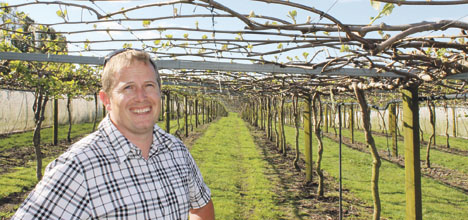
In late 2010, Braden Hungerford wasn't sleeping well. When he did, his dreams were filled with images of kiwifruit vines infected with the disease Psa-V and worries about his future – and that of five other families, who relied on the orchard he managed for their incomes.
Three years on, Braden's a different man. So confident is he in the bright future of the kiwifruit industry, he's planning to plant even more vines on the former family dairy farm near Te Puke – and he's looking forward to harvesting next autumn's green and gold crops.
In 2010, just a month after the virulent bacterial disease Pseudomonas syringae pv actinidiae V was identified in an orchard not far from his own, Braden made the tough decision to cut out 12 ha of kiwifruit in an effort to stop the spread of the disease.
'I don't want to sound like a martyr, but at that stage there was hope we could eradicate it and someone had to make the first move.”
Subsequently, it became apparent Psa could not be eradicated; and the focus turned to how to manage it. But on the Hungerford orchard, Hayward green, gold Hort16A and the new variety G9 were gone. Although he believed it was the right thing to do, Braden worried constantly about the chance of the orchard recovering and its ability to support those who relied on it for an income.
Accelerator
'Cutting out vines in summer is not the best time as it slows regrowth, while cutting out in winter stimulates growth. I'd never do it at that time of year again,” admits Braden.
'There's no point in looking back and regretting what's happened, but I am sorry I took my foot off the accelerator for a time and didn't push ahead with more re-grafting.”
The lucrative gold variety Hort16A is especially vulnerable to Psa; and in the last three years virtually all the vines in the Te Puke area have been removed, which is dramatically reducing inoculum levels – subsequently decreasing the risk of spreading the disease further.
It is widely accepted no orchard in Te Puke is free of the disease, but with careful and consistent management, including industry recommended best practice spray programmes, Braden says it is more than possible to grow productive crops.
Last season, the remaining Hayward Green vines on the orchard produced a record crop, despite Psa, and bud break this spring is looking promising. The prospects are also good for the new green G14.
'There's some evidence of leaf spotting and Psa can affect bud rot, but the G14 vines don't appear to die like they do in Hort16A – so we're hopeful of a good crop,” says Braden.
SunGold
A former Hort16A block was grafted to the new gold G3, also known as SunGold, in July 2012. The orchard employs five full-time staff plus Braden; and their care and attention to detail shows in the canopy tied down from the young vines.
'It's far less stressful having your own staff than using contractors, because you know the work will be done when it's required,” says Braden. 'And look at this, someone has taken the time to train this cane back to fill in the canopy and maximise fruit yield. The attention to detail in this block equates to many more trays of production,” says Braden, who is proud of how his staff have responded to the challenges and uncertainties caused by Psa.
'We are much better growers now than we were. We've put systems in place and begin each week with a staff meeting.”
That's held in the old cowshed where a large whiteboard records tasks to be carried out and by who ,as well as what's been done in previous weeks.
It's not been easy getting to the point where he can be confident of the future; and when he looks back at the last three years, Braden shakes his head at what's happened.
'If someone had told me back in early 2010 that in months I would be cutting out half the orchard, and during the next three years have five different jobs and end up growing two new varieties of kiwifruit, I wouldn't have believed them.”
Five jobs
Those five jobs have included roles with Kiwifruit Vine Health, helping other growers cope with the stresses of Psa on their orchards, and several roles with EastPack where he is now manager orchard productivity, as well as managing the Hungerford orchard owned by a company called MJF Ltd.
While Braden hopes the worst is over for Te Puke and Edgecumbe growers, in terms of the initial impacts of Psa-V, he says other regions are yet to experience that.
'I just hope they learn from the mistakes and successes we've been through, because it would be crazy not to.”
Psa has been a terrible scourge on the industry, but like many who have been through the highs and lows of the last three years, Braden believes it is emerging stronger and even more efficient.
'Orchardists who are not fully committed to growing kiwifruit will leave the industry, and those who remain will be the best growers.”
'Psa has meant more work, but I don't know of any other crop which gives the returns kiwifruit does. At $5 a tray, with a production of 10,000 trays a hectare, Hayward green is still a fantastic crop and the gold varieties are even better. Why wouldn't you give it your all?”

0 comments
Leave a Comment
You must be logged in to make a comment.