


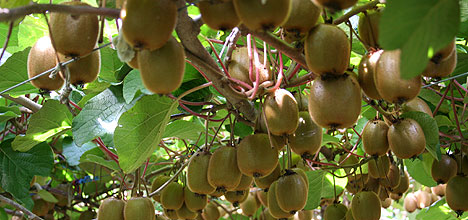
Today marks an unfortunate anniversary no one is likely to celebrate, but it is nonetheless an important one.
It is three years since the vine disease Pseudomonas syringae pv actinidiae, more commonly known as Psa-V, was first identified on a kiwifruit orchard near Te Puke - a bio-security incursion expected to cost the industry $885million.
It is three years to the day when Psa-V was first discovered in a kiwifruit orchard near Te Puke.
Last year a report by Lincoln University's Agribusiness and Economics Research Unit estimated 1410 jobs would be lost up until 2015, and Psa would cost the industry between $310-410million in impacts of the disease and the cost of responding to it.
A further $740-885million in lost development will be felt.
New Zealand Kiwifruit Growers Inc CEO Mike Chapman says cutting out gold Hort16A, and replacing it with the more Psa-tolerant Gold3, is estimated by the Ministry for Primary Industries to cost $25,100 per hectare.
When the cost of the Zespri licence to grow Gold3 is included, this totals $33,100.
'My calculation is more than 2000 hectares have been converted to Gold3 at a total cost of about $60million. Gold3 will not start producing a crop for two to three years; and each hectare is likely to have less than a full canopy due to Psa.
"Based on 2013 figures across the industry (before orchard expenses, debt repayment and drawings), a staggering $182million of income is not coming back to kiwifruit orchardists each year until they can grow a crop.”
Prior to November 2011, growers had been well aware of how the bacteria had devastated orchards in Italy.
News it was in Te Puke, in the heart of the prime kiwifruit growing region, spread shock and fear through the industry and wider communities so reliant on kiwifruit returns for their survival.
For individual growers, the disease has been a scourge seriously threatening their livelihoods and futures. Many also struggled with the emotional impacts of the disease.
Post-harvest companies, contractors and businesses which rely heavily on the industry for incomes have suffered too. Few would want to re-live the last three years.
Currently, 76 per cent of New Zealand's 3267 kiwifruit orchards have some vines infected with the disease and the only disease-free growing regions are Whangarei, North and West Auckland and the South Island.
But, despite dire predictions of doom and devastation cast in late 2011, the New Zealand kiwifruit industry has not died. In fact, three years on, there's a quietly growing optimism in its future.
The industry is emerging, as it has from other crises, in a leaner, more efficient and better-prepared way for any future biosecurity incursions.
It has not been easy, and there is a way to go before the industry can claim to be out of recovery mode and back into growth mode.
No cure has been found for Psa-V and nor is one likely. The best hope is growers can learn to manage it; and that Hayward Green and the new gold G3 will continue to show tolerance to the disease.
In future, new and even more tolerant varieties may be found, but for now these two carry the hopes and fortunes of the industry.

6 comments
Damage done
Posted on 05-11-2013 08:21 | By YOGI BEAR
Has been huge for many, so the reasons have not been fully given for it all either, I guess time washes over these things ...
Yeah well!!!
Posted on 05-11-2013 14:18 | By Sambo Returns
if the "boffins" had not tried to mess with nature, and growers were not so greedy, and the industry as a whole had stuck with green fruit, possibly none of this would have happened, the industry has only itself to blame!!!
If the shoe fits
Posted on 05-11-2013 18:19 | By Disappointed
Psa arrived very shortly after the National government made substantial cuts to frontline staff numbers in Biosecurity. Their lies the blame.
Get your fact right
Posted on 05-11-2013 22:03 | By TePukeCookie
PSA was first identified in 2010 but all indications are it was here undetected for 12 months and was imported with pollen and applied to a few orchards in spring 2009. It therefore came into the county just after National were elected, before any changes to Biosecurity were made.
bank attitudes
Posted on 05-11-2013 22:18 | By phoenix
Westpac bank are calling in their mortgages as they become due to exit this high risk industry.Even if you are up to date with your payments.
IKGA
Posted on 10-11-2013 13:20 | By I.K.G.A.
It's over 5 years since Zespri spent $1.165 million on an "Italian growers relief fund" for PSA increasing that in the financial year ended 31 March 2010 to just over $3,000,000. At least 2 years warning and they did not:- 1.Alert Biosecurity to the potential impact of the disease and insist on a ban on the import of any plant material. 2. Conduct a scientific literature review on PSA. 3.Undertake any contingency planning for an incursion. The same Directors and management remain in charge. Why blame MPI or the government when the monopoly seller with a monopoly on information chose to ignore the warning signs from Italy and do just about nothing to look after NZ growers but spent $3 million on Italian growers ?? Is that the governance and management of a "world class" company ?
Leave a Comment
You must be logged in to make a comment.