


The kiwifruit industry is hoping it is not facing a new threat to its crop following a discovery of symptoms in some kiwifruit vines which have proved negative in tests for the bacteria Psa-V.
Kiwifruit Vine Health chief executive Barry O'Neil says investigations are being made into a number of orchards outside the Bay of Plenty with vines that appear to have typical Psa-V symptoms, but have returned ‘not detected' test results.
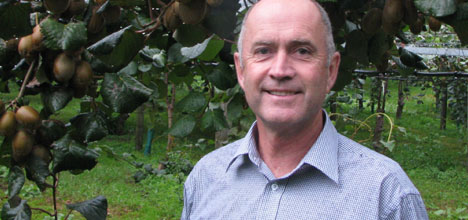
Barry O'Neil, chief executive of Kiwifruit Vine Health says KVH will investigate any possible new diseases, so prompt action can be taken.
'These orchards are being re-tested – and we are also looking to identify whether other bacteria or viruses are causing these symptoms.”
Barry says at this stage there is no cause for heightened concern that a new pathogen may be involved, as the symptoms of red exudate and leaf spotting can be caused by other factors, including frost damage as well as bacteria and virus infections.
'For example, the cherry leaf roller virus is known in New Zealand and can cause symptoms not dissimilar to Psa. It could also be that Psa is the cause, but the bacteria hasn't shown up in tests.”
However, there are other types of Psa-V bacteria from the one presently in New Zealand, say Barry, including strains in Japan and Korea which tend to affect green vines more seriously than gold – and KVH and the industry are anxious to ensure they don't arrive in this country.
Barry says it could be several weeks before the test results are known, because it takes time to culture bacteria in laboratories and samples may be sent to the Ministry for Primary Industries, and Landcare Research, if a viral infection is suspected.
While the symptoms may not indicate anything sinister, it is the role of KVH to investigate any possible new diseases so that prompt action can be taken, says Barry.
KVH is also warning pollen companies and growers of the importance of maintaining high hygiene standards when testing pollen for viability.
'This follows a recent detection of Psa-V in pollen sourced from the South Island, which had been opened for viability testing at a pollen mill in a region where Psa is present.
'It appears while sampling the pollen it was contaminated with Psa-V. If viability testing is required, it should occur at the source mill. Pollen jars [pottles] must be correctly identified, so that traceability is maintained.”
Barry says the pollen had been brought from the South island by a North Island grower, who wanted to use Psa-free pollen on his orchard; and it would not be returning to the South island, which is currently believed to be free of the disease.
KVH will be reviewing its Pollen Protocol in light of this recent contamination event, says Barry.

0 comments
Leave a Comment
You must be logged in to make a comment.