


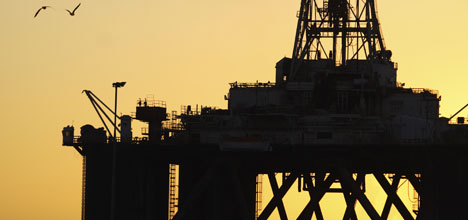
Greenpeace's oil pollution maps claiming to show the results of oil well blowouts off the New Zealand coast are being labelled science fiction by Petroleum Exploration and Production Association New Zealand chief executive David Robinson.
The website says drilling rights in the ocean surrounding New Zealand are being sold off to big oil companies, with Texan oil company Anadarko set to begin deep sea exploratory drilling this summer off our coasts.
The website also says exploratory drilling is the most dangerous part of oil production and adding the challenges of drilling in very deep water compounds the risks; and that a spill from a deep water well could result in oil flowing freely into the ocean for many weeks.
'We see it [the Greenpeace maps] as science fiction and scare mongering. It's remotely possible but so unlikely that it doesn't really become realistic,” says David.
Reasons for PEPANZ's stance include that Greenpeace has to find something in one of the exploratory wells, and secondly it has to be black oil – when New Zealand wells are typically gas, condensate and some light crude oils, says David.
'We have never found heavy crude oil in New Zealand. So first we have to find something then it has to be heavy crude oil, again unlikely.
'The third thing that has to happen, which is a really, really critical point, is that it has to be under very, very high pressure.”
New Zealand wells are so low pressure that submersible pumps have to pump the oil out of the well – there is not enough pressure to get the oil to the surface.
The average pressure of wells in Taranaki is 7000 psi, says David. The pressure in the Gulf of Mexico by comparison was 17,000 psi.
'It's a quantum difference between the two.
'So we have to find it, it's got to be black oil, it's got to be under pressure – then we have got to actually lose control of the well, which is a very, very rare occurrence.”
All the safeguards and safety barriers that are in place during drilling would have to fail, and then the blow out preventer would have to fail as well, says David.
Greenpeace assumes nothing will be done for 76 days after a well head blow out; that the oil will just keep pouring out for months on end.
Furthermore, Greenpeace says it will take that time to find, hire and tow a drilling rig to New Zealand to drill a relief well.
'Relief wells may or may not be required,” says David. 'Wells are now designed to have capping stacks fitted to them, which were not available when the Gulf of Mexico well blew.
'Now they are standard equipment and are in strategic locations around the world. And they are designed to be deployed to pretty much anywhere around the world.
'They are all modularised and ready to go on planes now. And it's not just the capping stack, it's the equipment you need to fit it, and clear any debris from round the well head and prepare the well head for the capping device.
'So we have plans in place to fly the equipment here, deploy the equipment, the vessels to deploy it on fit it and stop any well – and that would be in the order of a few weeks.
'When we put all of those things together this particular model is remotely possible, but incredibly unlikely.”
PEPANZ has, since 1972, been the national body representing upstream oil and gas exploration and production industry.
Representing major companies that explore for and produce New Zealand's oil and gas resources, PEPANZ aims to secure conditions that enable member companies to operate safely, sustainably and profitably.
The association also seeks to increase community and government understanding of the upstream petroleum industry, by publishing information about the sector's activities and economic importance to the nation.
The Greenpeace scenario of a Deepwater Horizon-style well-head blowout off the New Zealand coast is being published in graphic form showing the cumulative effects of a 10,000 barrel a day blowout.
Using Texan oil company Andarko Petroleum's North and South Island well sites as the focus, the scenario is of a spill that will impact the North Island's west coast from the Hokianga to Cape Egmont during a period of six weeks.
Andarko is expected to drill an exploratory well off the Dunedin coast this summer.
The claim by Greenpeace is the oil industry and the Government are keeping New Zealanders in the dark about the real risks of deep water drilling.
Greenpeace's website http://oilspillmap.org.nz depicts an oil spill model for New Zealand.

9 comments
Most will Agree
Posted on 27-10-2013 14:19 | By carpedeum
Many other people from a scientific background would agree with David Robinson-one was the Professor who spoke on The Nation ( tv3) this morning-she was balanced and informative without being emotive
Surprised??
Posted on 27-10-2013 15:04 | By verandric
Did anybody expect any other than baised propaganda from Greenpeace? As they are anti anything to do with mining, oil, etc. they are hardly likely to to produce a report that doesn't support their viewpoint. Perhaps we need to treat them the same contempt that the Russians have.
Rastus
Posted on 27-10-2013 16:00 | By rastus
I would have thought that the news media would have been more responsible and not have given this totally discredited bunch of thugs any coverage for again an emotive load of garbage - why do we have to be continually ear bashed by this law breaking load of terrorists.
The greens !!!
Posted on 27-10-2013 16:22 | By Ross01
If the greens are determined to be panic mongers over the unlikely occurrence of an event, how on earth will they behave if they get a sniff of political power in the future
Rena was unlikely as well.
Posted on 27-10-2013 16:55 | By dgk
One thing the Rena disaster taught us, is that unlikely doesn't mean impossible. And we're still cleaning up from that mess.
Oil at sea.
Posted on 27-10-2013 17:22 | By Watchdog
What greatly concerns me is the few weeks they say it would take to get the problem sorted. This happened when the Rena stranded and there was 6 weeks of virtual inaction. The window of opportunity for unloading the ship and getting her towed off again was lost. Then of course we know the rest. She broke up and we got hundreds of tonnes of oil. Bet it can't happen again? Yeah right!
So all you greenies
Posted on 27-10-2013 22:53 | By FunandGames
jump in your cars that don't use oil and go to the next protest.
Believe it or not
Posted on 28-10-2013 06:27 | By Disappointed
One cannot help but draw comparisons between the Petroleum Exploration and Production Association's "Nothing to see here" as Anadarko are about to commence drilling on the West Coast and a recent article by a major local paper that headlined "No signs of oil on Bay's beaches" as we head into the summer holiday season. The comparison is that both are a convenient untruth.
Greenpeace responds
Posted on 31-10-2013 10:12 | By AGP
When I was in Wgtn yesterday, I was interested in reading Greenpeace's response to the dismissal of their spill modelling by the Govt. It's well worth a read: http://www.stuff.co.nz/dominion-post/comment/columnists/9340350/Deep-sea-drilling-does-not-add-up-to-a-win
Leave a Comment
You must be logged in to make a comment.