


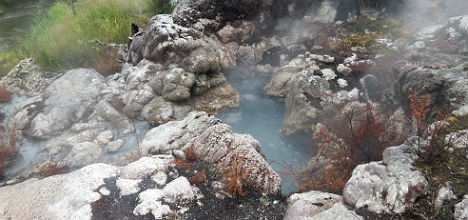
One of Rotorua's most iconic geysers is showing signs of rejuvenation after being dormant for 34 years.
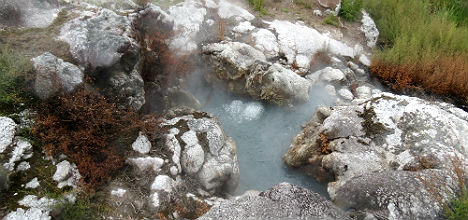
Papakura Geyser at Whakarewarewa (Te Puia) was once known for its spectacular and continuous hot water eruptions which reached heights of two-three metres.
The grass surrounding the geyser has been burnt by hot water.
GNS scientists say its failure in 1979 lead to the enforced closure of dozens of hot water bores in Rotorua in 1992.
Since 1979 Papakura has not had an eruption, vent temperatures have been cool, and scientists have detected less geothermal fluids inside the geyser vent.
During a recent monitoring visit, GNS Science staff Duncan Graham and Liam O'Halloran found evidence the geyser may be returning to its former magnificence.
A pool that had been cool for 20-plus years had erupted and was overflowing at 97 degrees Celsius.
"The signs we saw are very encouraging," says volcanologist Brad Scott, one of the GNS Science team who have worked on the Rotorua Geothermal System since the bore closures in the 1990s.
GNS Science is involved in two significant projects at Rotorua.
The first is a programme of monthly monitoring of 40 selected geothermal surface features for the Bay of Plenty Regional Council.
This work is conducted as part of the management plan for the Rotorua Geothermal System.
The second project is a long-term research programme focused on the shallow geo-hydrology and chemistry of the Rotorua Geothermal System, led by geochemist Ed Mroczek.
'The bore closure programme of the 1990's has created a unique opportunity to study the recovery of an exploited geothermal system,” says Ed.
'There has been very positive recovery of geothermal surface features in the northern portion of the Rotorua Geothermal system at Kuirau and Ohinemutu, but it has not been so clear in the Whakarewarewa-Te Puia area.” He says with careful management and appropriate technologies, you can have both use and protection of the geothermal features for the economic benefit of Rotorua and the country.
'Elevated levels of chloride geothermal fluid in the hot water at Whakarewarewa indicated that pressure had increased and water from deeper in the earth was being pushed toward the surface.”
Scientists had also noticed an increase in geothermal water coming into the ‘throat' of geyser features like Waikite, Wairoa and Papakura over the past year or so.
"This is a promising sign. Our monitoring has shown that not all geysers and springs have returned to their former state, but it is really encouraging to see signs of activity at several features.”

0 comments
Leave a Comment
You must be logged in to make a comment.